How Long Is a Chess Game? Casual, Blitz, Rapid and Tournament
Nov 23, 2026 · The Editors
How long a chess game lasts: casual games, bullet, blitz, rapid and classical time controls, how long tournament and world championship games take, the average number of moves, and the longest game on record.
A chess game lasts as long as its time control allows. A casual game without a clock usually takes 10 minutes to an hour. With a clock, a bullet game is over in a few minutes, blitz in up to about 20, rapid in roughly 20 minutes to two hours, and a classical tournament game commonly runs four to six hours. A typical game between experienced players lasts somewhere around 40 moves.
How long chess games last, by time control
The international federation, FIDE, classes games by how much time each player has. Online sites use similar names, with their own exact cut-offs.
| Type | Time per player | Whole game, roughly |
|---|---|---|
| bullet | under 3 minutes | 1–6 minutes |
| blitz | 3 to 10 minutes | 5–20 minutes |
| rapid | more than 10 and less than 60 minutes | 20 minutes to 2 hours |
| classical | 60 minutes or more | 2–6 hours or longer |
| casual, no clock | unlimited | usually 10–60 minutes |
The "whole game" column is longer than double the clock time when a bonus (increment) is added each move; see below.
How long is a tournament chess game?
Many classical tournaments use a control such as 90 minutes for the first 40 moves, then 30 more minutes, with 30 seconds added for every move from the start. Under that control a long game can run five or six hours. World championship matches use even longer controls, roughly two hours per player for the first 40 moves. Club evenings often use shorter classical or rapid controls so the game finishes the same night.
Why the clock changes everything
Without a clock, a slow thinker can take as long as they like over a move, and casual games drift. A chess clock gives each player a fixed bank of time: you make your move, press your button, and your clock stops as your opponent's starts. Run out of time and you lose (unless your opponent cannot possibly checkmate you). There are three common settings:
- Sudden death: a fixed amount of time for the whole game.
- Increment (bonus): extra seconds added after every move, so you never get stuck with nothing.
- Delay: your clock waits a few seconds before it starts counting down each move.
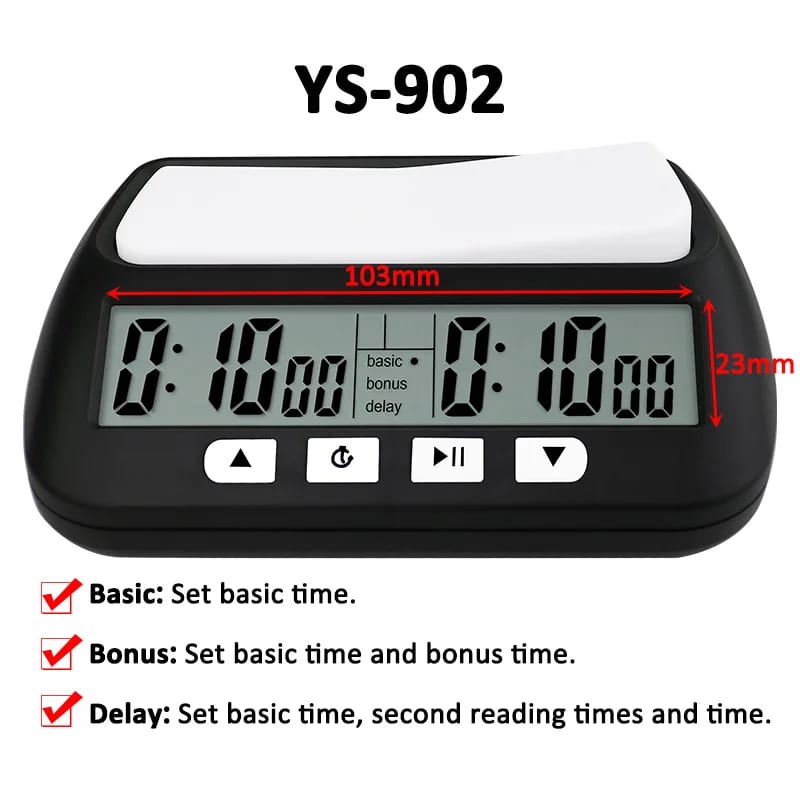
A digital chess clock with basic, bonus and delay timing handles all three. The rules of using one are in chess clock rules.
How many moves is an average chess game?
Estimates vary with the players and the time control, but a game between experienced players lasts roughly 40 moves on average. Short games happen: the fastest possible checkmate, fool's mate, takes two moves. Long endgames can pass 100 moves, though the fifty-move rule lets a player claim a draw after fifty moves each with no capture and no pawn move.
The longest chess game
The longest tournament game usually cited was played in Belgrade in 1989 between Ivan Nikolić and Goran Arsović: 269 moves, lasting more than 20 hours, and drawn. Changes to the rules since then, including an automatic draw after 75 moves without a capture or pawn move, make a repeat unlikely.
How to make casual games shorter
- Use a clock. Even 15 minutes each keeps a game to about half an hour.
- Agree a draw when neither side can make progress; see insufficient material and threefold repetition.
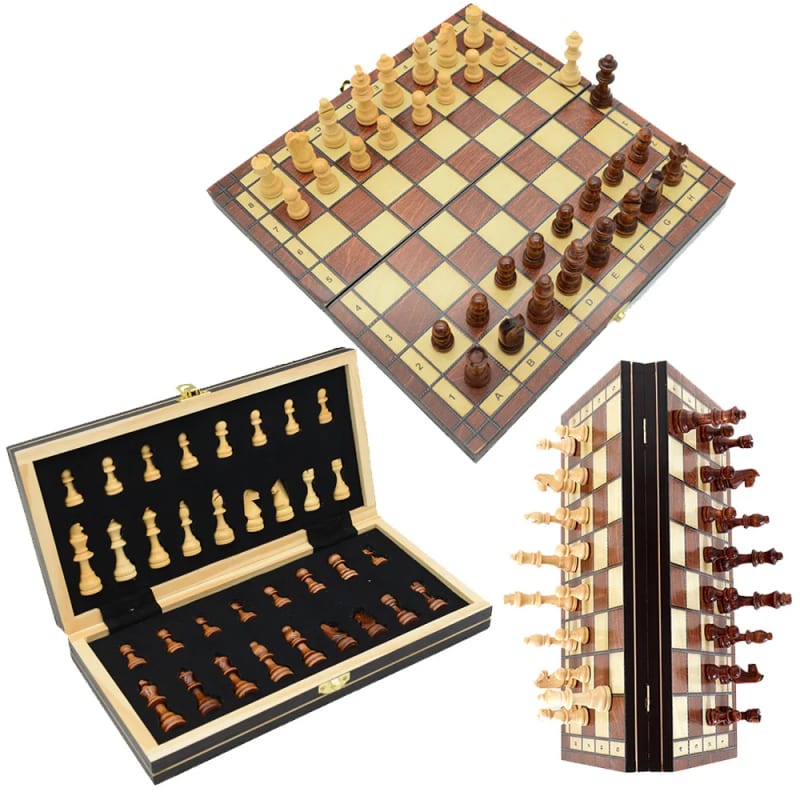
- Keep a set ready. A magnetic folding chess set can be left mid-game and finished later.
Frequently asked questions
How long does a chess game usually take?
A casual game without a clock usually takes 10 minutes to an hour. Blitz games take minutes; classical tournament games can take four to six hours.
How long is a chess game in a tournament?
It depends on the time control. Classical events often allow 90 minutes or more per player plus a bonus per move, so games can last several hours. Rapid and blitz tournaments are much quicker.
How long is a chess game with a timer?
At most about twice the time on each clock, plus any bonus seconds added per move. A 5-minute blitz game, for example, cannot last much more than 10 minutes.
What is the longest chess game ever played?
The longest tournament game usually cited is Nikolić against Arsović, Belgrade 1989: 269 moves over more than 20 hours, ending in a draw.