Fool's Mate: The 2-Move Checkmate in Chess (and How to Avoid It)
Nov 13, 2026 · The Editors
Fool's mate is the fastest possible checkmate in chess: Black mates in two moves. The moves, why it works, the version White can play, and how to make sure it never happens to you.
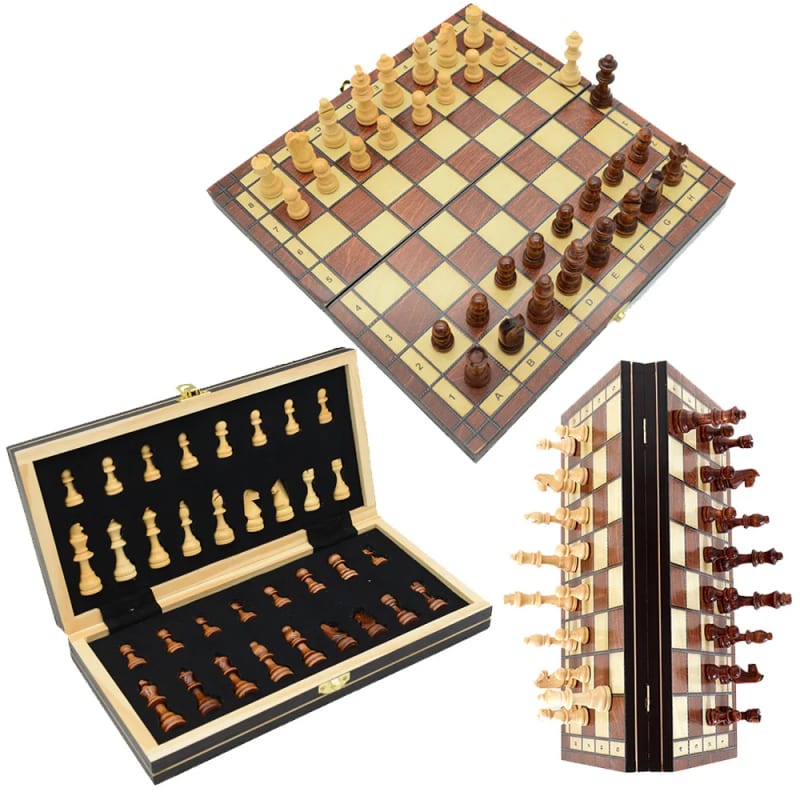
Fool's mate is the fastest possible checkmate in chess: Black checkmates White on Black's second move. It only happens if White plays two very weak pawn moves that open the diagonal to the white king.
The fool's mate moves
The standard sequence is:
- White: f3 (pawn from f2 to f3)
- Black: e5 (pawn from e7 to e5)
- White: g4 (pawn from g2 to g4)
- Black: Qh4# — the queen comes out to h4, and it is checkmate.
In chess notation that is 1. f3 e5 2. g4 Qh4#.
The same mate works if White plays f4 instead of f3, or if Black plays e6 instead of e5. What matters is that White has moved both the f-pawn and the g-pawn, and Black's queen has a clear path to h4.
Why it is checkmate
After White's two pawn moves, the diagonal from h4 to e1 is wide open. The black queen on h4 checks the king, and:
- The king cannot move. The queen, bishop and pawns fill d1, f1, d2 and e2, and the one empty square, f2, is on the queen's diagonal.
- Nothing can block the diagonal: there is no white piece that can reach g3 or f2.
- Nothing can capture the queen on h4.
Check with no escape, no block and no capture is checkmate.
Why it is called fool's mate
Because only a fool would allow it. Both of White's moves weaken the king and do nothing for development, and no experienced player would play them together. The name is old; it appears in chess books going back centuries.
Fool's mate for White
White cannot mate in two, because White moves first and Black would have to cooperate. The fastest mate White can deliver is in three moves, with the same pattern mirrored:
- e4 g5 2. d4 f6 3. Qh5#
Again Black has weakened the f- and g-pawns, and the white queen lands on the open diagonal.
How to avoid fool's mate
- Do not move the f-pawn and g-pawn early. Those pawns guard your king's diagonal.
- Develop knights and bishops first, and fight for the centre with the e- and d-pawns.
- Castle early. A castled king is far harder to mate. See castling rules.
- Ask after every move: what is my opponent threatening? Most short mates are missed threats, not clever play.
Fool's mate vs scholar's mate
Fool's mate is a two-move accident; scholar's mate is a four-move attack on f7 with queen and bishop that beginners really do fall for. Learn to stop both and you have closed the two most common beginner traps. For a full grounding, see chess openings for beginners and chess rules for beginners.
Frequently asked questions
What are the moves of fool's mate?
- f3 e5 2. g4 Qh4#. Black checkmates on the second move. It also works after f4 instead of f3, or e6 instead of e5.
Is fool's mate the fastest checkmate in chess?
Yes. Two moves by each side is the shortest possible game ending in checkmate.
Can White do fool's mate?
Not in two moves. The fastest White checkmate is in three moves, for example 1. e4 g5 2. d4 f6 3. Qh5#.
Does fool's mate happen in real games?
Very rarely, and only between complete beginners, because it needs White to make two very poor moves in a row.