Threefold Repetition in Chess (and the 50-Move Rule)
Nov 14, 2026 · The Editors
Threefold repetition rule in chess: what counts as the same position, how to claim a draw, fivefold repetition, and the 50-move and 75-move rules, with examples.
Under the threefold repetition rule, a chess game is a draw when the same position appears three times with the same player to move and the same castling and en passant rights. The moves do not have to come one after another. Under the related 50-move rule, a player can claim a draw when 50 moves by each side have passed with no capture and no pawn move.
These rules stop games going on forever, and they are among the most common ways games are drawn at club level besides agreement and stalemate.
What counts as the same position
For threefold repetition, a position counts as repeated only if all of these match:
- The same pieces on the same squares.
- The same player to move.
- The same castling rights — if a king or rook has moved since, the position is different, even if it looks the same.
- The same en passant possibility.
The repetitions do not need to be consecutive. A position can appear on move 20, again on move 31 and again on move 40, and the third time counts.
Threefold repetition example
The classic case is perpetual check: one side checks, the king steps aside, the checking piece checks again, and the king steps back. After the same position comes up for the third time, the game can be drawn. Often a player who is losing will look for a perpetual check to save the game.
How to claim a threefold repetition draw
Under FIDE rules the draw is not automatic on the third repetition — a player must claim it:
- On your turn, if your next move will produce the position for the third time, write the move on your scoresheet (do not play it) and claim the draw. Or, if the position has just appeared for the third time, claim before making your move.
- Stop the clock and call the arbiter.
- The arbiter checks. If the claim is wrong, the opponent usually gets extra time and the game continues.
In casual play, players simply agree. Online, most sites apply the draw automatically.
Fivefold repetition
Since 2014, FIDE rules also include fivefold repetition: if the same position appears five times, the game is drawn automatically, with no claim needed.
The 50-move rule in chess
A player may claim a draw if the last 50 moves by each player (so 100 moves in total) have been made without any capture and without any pawn move. The count starts again after every capture or pawn move.
The claim works the same way as for repetition: on your turn, claim with the arbiter.
The 75-move rule
Also since 2014, if 75 moves by each player pass with no capture or pawn move, the game is drawn automatically — unless the last move gave checkmate.
50-move rule exceptions
At times in the past FIDE allowed more than 50 moves for certain endgames that computers showed could take longer to win, such as some positions with two knights against a pawn. Those exceptions were dropped, and today the 50-move rule applies to all positions in FIDE play.
Repetition rules at a glance
| Rule | Condition | Draw |
|---|---|---|
| Threefold repetition | Same position three times | Must be claimed |
| Fivefold repetition | Same position five times | Automatic |
| 50-move rule | 50 moves each, no capture or pawn move | Must be claimed |
| 75-move rule | 75 moves each, no capture or pawn move | Automatic |
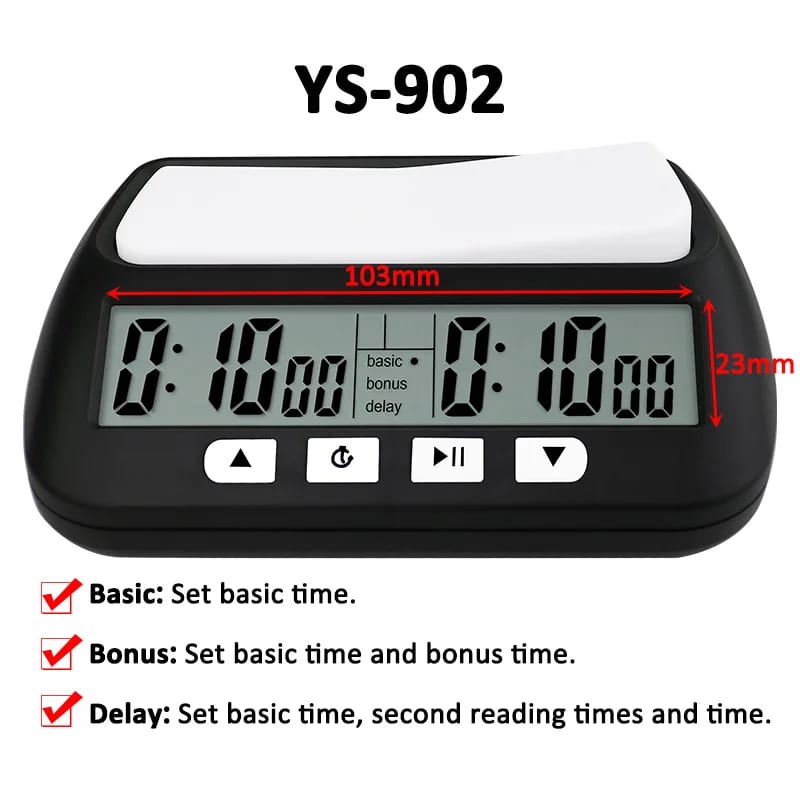
A chess clock makes claims easy at a home tournament, and keeping score with chess notation is how you prove a repetition.
Frequently asked questions
What is threefold repetition in chess?
It is a rule that lets a player claim a draw when the same position, with the same player to move and the same castling and en passant rights, appears three times.
Do the repeated moves have to be in a row?
No. The same position just has to appear three times at any point in the game.
Is threefold repetition automatic?
Not in over-the-board FIDE play — a player must claim it. Fivefold repetition is automatic. Most online sites draw on threefold repetition automatically.
What is the 50-move rule in chess?
A player can claim a draw if 50 moves by each side have been made without a capture or a pawn move.