Chess Clock Rules: How to Use a Chess Timer
Nov 4, 2026 · The Editors
Which hand presses the clock, what increment and delay mean, the common time controls, and what happens when a flag falls.
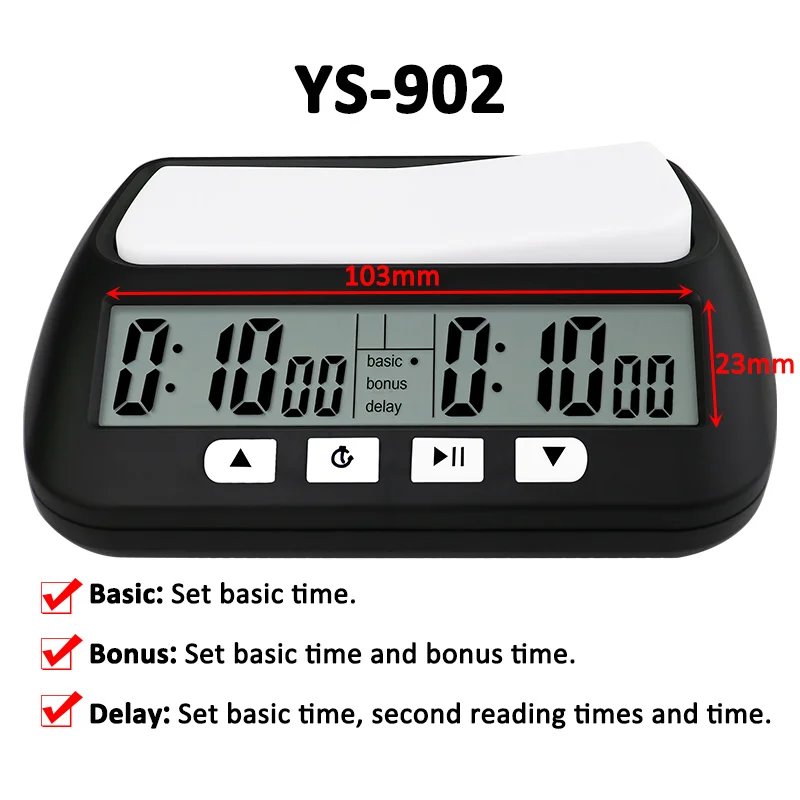
A chess clock is two timers in one case, joined so that only one runs at a time. When you finish your move you press your button, which stops your clock and starts your opponent's. It turns a friendly game into a real one, and stops the player who takes twenty minutes over every move.
Setting up
- Put the clock beside the board, not in front of either player. Traditionally the player with Black chooses which side it goes on.
- Set both sides to the agreed time.
- When everyone is ready, Black starts White's clock, and White makes the first move.
Pressing the clock
- Make your move, then press your button. Pressing before your move is finished does not count.
- Press with the same hand you moved with. This is the formal rule, and it stops anyone moving with one hand while the other hovers over the clock.
- Do not hold your hand over the clock, and do not press it hard enough to knock it over.
Time controls
A time control is written as minutes plus seconds: 5+3 means five minutes each, plus three seconds added after every move.
- Bullet: under three minutes each. Frantic.
- Blitz: three to ten minutes each — 3+2 and 5+3 are common.
- Rapid: ten to sixty minutes — 10+5 and 15+10 are popular.
- Classical: an hour or more each, the time used in serious tournaments.
For friendly games at home, 10 or 15 minutes each with a few seconds of increment is a good starting point.
Increment and delay
Most digital clocks offer two ways of adding time:
- Increment (also called bonus or Fischer time): a few seconds are added to your clock after every move. If you move quickly, your time can build up.
- Delay: your clock waits a few seconds before it starts counting down each move. If you move within the delay, you lose no time at all — but you never gain any.
Both stop a game being lost on the clock in a position where a player is moving perfectly sensibly but has run out of seconds.
When time runs out
When a player's time reaches zero, their flag falls and they lose — with one important exception. If the opponent has no possible way to checkmate, even with the worst play, the game is a draw instead. A lone king cannot win on time.
The opponent must notice and claim it; in a friendly game, the clock showing zero is usually enough.
Why use a clock at home
It makes games finish, keeps both players honest about time, and is the single best way to improve: a clock forces you to decide. Start with long games and shorten them as you get quicker.
Mentioned above