Go Handicap Stones: How the Handicap System Works and Where the Stones Go
Nov 18, 2026 · The Editors
In go, a weaker player takes Black and places handicap stones on the board before White's first move, usually one stone per rank of difference. How many stones, where they go on 19×19, komi in handicap games, and smaller boards.
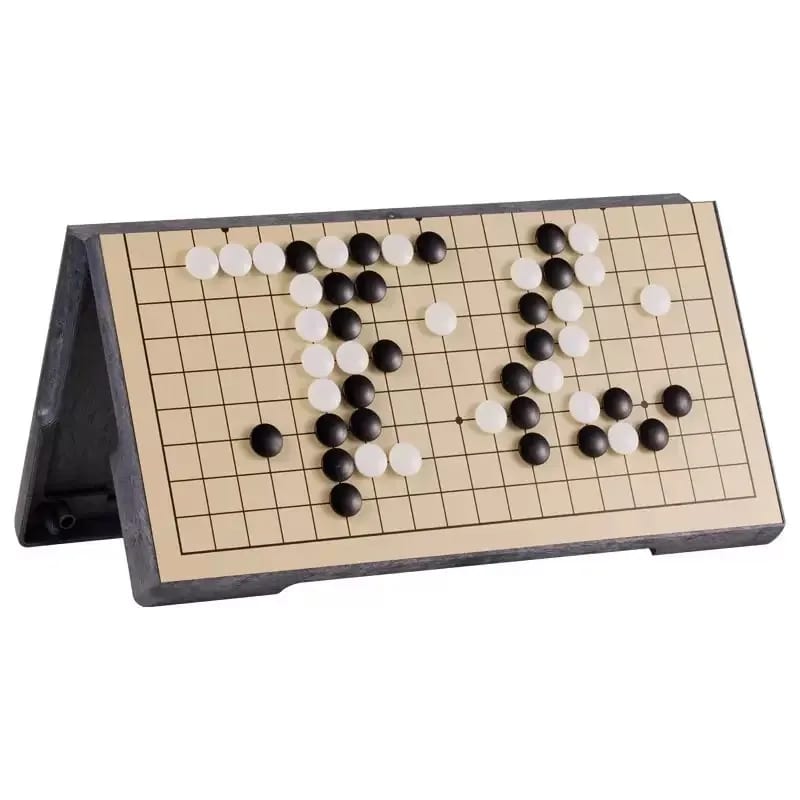
In go, the handicap system lets players of different strength have a close game. The weaker player takes Black and places extra stones on the board before the game starts; White then moves first. As a rule of thumb, Black gets one handicap stone for each rank of difference between the players, up to nine stones.
How many handicap stones?
Amateur go ranks run from kyu grades (weaker, counting down) to dan grades (stronger, counting up), and each rank is roughly one stone of strength.
| Rank difference | Handicap |
|---|---|
| none | even game: Black plays first, White gets komi |
| 1 | Black plays first with no komi (or half a point) |
| 2 | 2 stones |
| 3 | 3 stones |
| … | … |
| 9 or more | 9 stones (the usual maximum on 19×19) |
Clubs and servers differ slightly in how they convert ranks to stones, so check the local custom.
Where the handicap stones go on a 19×19 board
Under Japanese and Korean rules, handicap stones go on fixed star points (the marked dots, or hoshi). From Black's side of the board, the common placements are:
| Stones | Placement |
|---|---|
| 2 | upper-right and lower-left corners |
| 3 | the two above, plus lower-right |
| 4 | all four corner star points |
| 5 | four corners plus the centre (tengen) |
| 6 | four corners plus the middle star points on the left and right sides |
| 7 | the six above plus the centre |
| 8 | four corners plus all four side star points |
| 9 | all nine star points |
Under Chinese rules, the handicap stones are traditionally placed freely: Black may put them anywhere. Because Chinese rules count territory and stones together, White is often given extra points to balance the extra stones; how many depends on the rule set.
Komi in handicap games
Komi is the points White receives for moving second in an even game, typically 6.5 under Japanese rules and 7.5 under Chinese rules. In a handicap game, Black's stones replace komi: White usually gets no komi or half a point, the half point only to prevent a tie.
Handicaps on smaller boards
Each handicap stone is worth much more on a small board, so the system is scaled down.
- 9×9: two or three stones is already a large handicap. Many players adjust komi instead of adding stones.
- 13×13: handicaps are usually smaller than on 19×19, and the stones go on the 13×13 star points.
Small boards are where beginners start; see go board sizes.
How to play a handicap game well
As Black: use the stones. They give you strength in every corner, so play solidly, connect your groups and avoid fights you do not need. A big lead only has to be kept, not increased.
As White: play flexibly, keep many possibilities open and look for overplays. Strong players learn a great deal from giving handicaps, because they must make the most of every move.
A handicap game is the fairest way for a beginner to play a stronger friend: both have to play their best. For the basic rules, see go game rules for beginners, and for the next steps, go strategy for beginners. A folding go set with bowls has everything you need; a digital clock keeps timed games honest. The ko rule applies in handicap games exactly as in even ones.
Frequently asked questions
How does the handicap work in go?
The weaker player takes Black and places extra stones on the board before White's first move, usually one stone per rank of difference. White then plays first.
Where do you put handicap stones in go?
Under Japanese and Korean rules, on fixed star points: two stones on opposite corners, four on all corners, nine on all nine star points. Under Chinese rules they are traditionally placed freely.
Is there komi in a handicap game?
Usually only half a point, or none. The handicap stones take the place of komi.
What is the maximum handicap in go?
Nine stones is the usual maximum on a 19×19 board. Larger gaps are often played with nine stones and extra points.
Mentioned above