Go Strategy for Beginners: 10 Principles to Win More
Nov 10, 2026 · The Editors
Go strategy for beginners: why corners come first, how to make a group live with two eyes, atari and ladders, sente, when to tenuki, and the habits that help new players most.
Go has very few rules — you place stones, surround territory and capture stones with no liberties — but the strategy takes a lifetime. The ten principles below are the ones that make the biggest difference in a beginner's first hundred games. If you are new to the rules themselves, read go game rules for beginners first.
1. Corners first, then sides, then the centre
It takes fewer stones to surround territory in a corner (the edges do half the work) than on a side, and fewer on a side than in the centre. That is why strong players open in the corners. A traditional saying puts it plainly: corners are gold, sides are silver, the centre is grass.
2. A group needs two eyes to live
An eye is an empty point surrounded by your stones. A group with two separate eyes can never be captured, because the opponent can never fill both at once. A group with one eye can be surrounded and taken. When a group is under attack, your first question is: can it make two eyes?
3. Count liberties
Every capture in go comes down to liberties — the empty points next to a group. When two groups are fighting, count each side's liberties. The one with more usually wins the race. A group with one liberty left is in atari and can be captured next move.
4. Learn the ladder
A ladder is a chain of ataris that chases a stone diagonally across the board. If there is no friendly stone in its path, the chased stone is captured at the edge. Before you run from atari, look along the diagonal: if the ladder works against you, do not run.
5. Keep sente
A move your opponent must answer is played with sente (initiative); a move they can ignore is gote. Players who keep sente decide where the game is played. Before a move, ask: will my opponent have to answer this?
6. Do not play too close to strong groups
Placing stones right next to your opponent's strong, settled groups only makes them stronger. Play away from strength — yours and theirs.
7. Use your strong groups to attack
The flip side: a strong wall of your own is not territory in itself. Use it to push weak enemy stones towards it, where they can be captured or forced to live small.
8. Know when to tenuki
Tenuki means ignoring your opponent's last move and playing elsewhere. Beginners answer every move locally. Often the biggest point on the board is somewhere else entirely.
9. Do not save every stone
Giving up a stone or two to gain a better position, or sente, is normal. Clinging to weak stones is one of the most common ways to lose a game.
10. Start small
Play your first games on a 9×9 board. Games are short, mistakes show up quickly, and you learn life and death far faster. Move up to 13×13 and then 19×19 once 9×9 feels easy.
Go strategy at a glance
| Principle | Ask yourself |
|---|---|
| Corners first | Is there a big empty corner? |
| Two eyes | Can my group live? Can theirs? |
| Liberties | Who wins this capturing race? |
| Ladders | Does this chase work for me? |
| Sente | Does my opponent have to answer? |
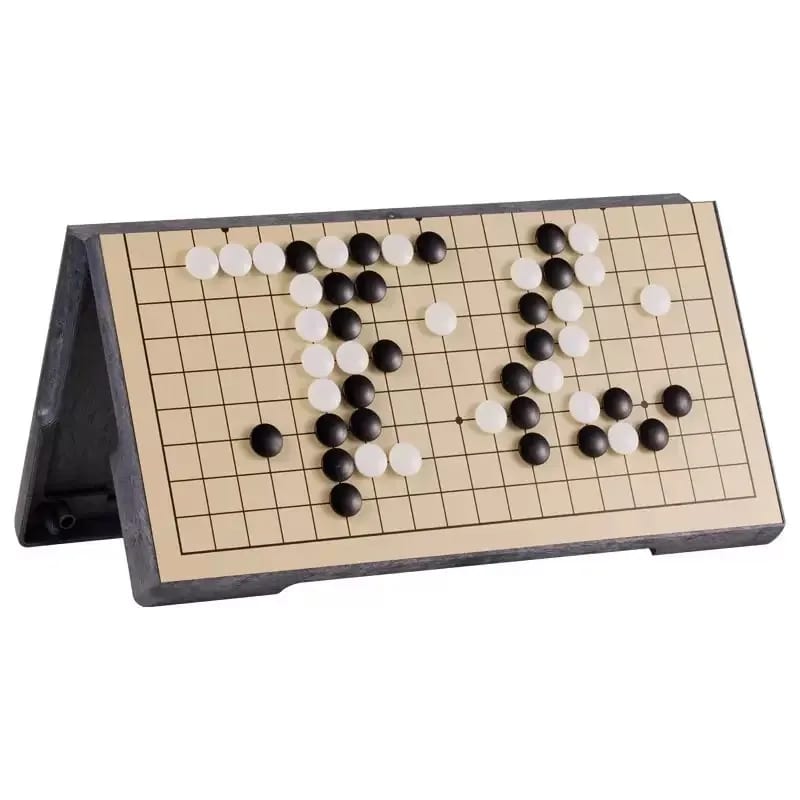
A board to practise on
Go is best learned on a real board, where you can replay a game stone by stone. A folding go set packs board and stones away together. If you are coming from chess, our go vs chess comparison explains what changes.