Go Game Rules for Beginners: How to Play Go
Nov 4, 2026 · The Editors
Stones, liberties, capture, ko and counting territory — the rules of go, the oldest board game still played, for a first game.
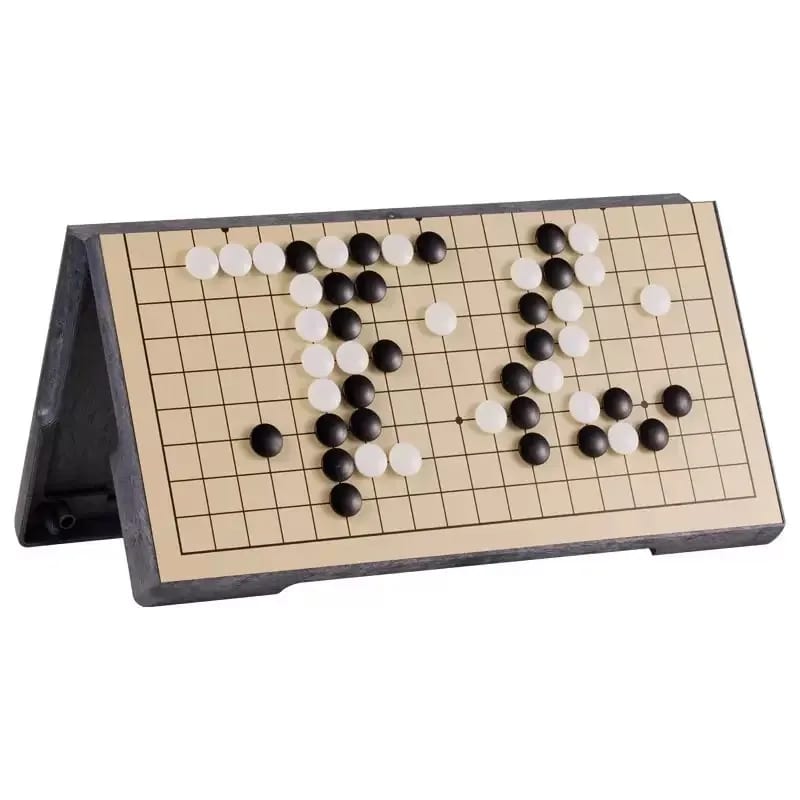
Go is played by two people placing black and white stones on the intersections of a grid. The rules are among the simplest of any board game. The strategy is so deep that computers only learned to beat the best human players in 2016. It is called weiqi in China, go in Japan and baduk in Korea.
The board and stones
A standard board is a grid of 19 by 19 lines. Beginners often play on a smaller area — 9 by 9 or 13 by 13 — and you can mark one out on the corner of a full board. Stones go on the intersections, not in the squares.
Black has the black stones, White the white. Black plays first.
Placing stones
Players take turns placing one stone on any empty intersection. Once placed, a stone never moves — unless it is captured.
Liberties
The empty intersections directly next to a stone — up, down, left, right — are its liberties. Stones of the same colour that touch along the lines form a group and share their liberties.
Capturing
When a stone or group has no liberties left, because the opponent has filled them all, it is captured and removed from the board. The capturing player keeps the stones as prisoners.
Two more rules
- No suicide: you may not place a stone where it would have no liberties, unless doing so captures opposing stones and frees it.
- Ko: you may not make a move that returns the board to exactly the position it was in after your previous turn. This stops two players capturing a single stone back and forth for ever. When a ko arises, you must play somewhere else first before you can retake.
Ending the game
There is no checkmate. The game ends when both players pass in succession, because neither can gain anything more.
Scoring
Each player scores for the territory they surround — the empty points enclosed by their stones — and for the stones they have captured. (Chinese-style scoring counts territory plus your stones on the board instead; the result is almost always the same.)
Because Black moves first, White receives komi, a few points of compensation, usually 6.5 or 7.5. The half point means there are no draws.
Advice for a first game
- Play in the corners first, then the sides, then the centre: corners are the easiest places to make territory.
- A group with two separate enclosed empty points — two eyes — can never be captured. Learning to make two eyes is learning go.
- Lose your first fifty games quickly. Everyone does.
A little history
Go was played in China more than 2,500 years ago and is the oldest board game still played in something like its original form. It reached Korea and Japan around the fifth to seventh centuries, and Japan's go schools made it a profession.
The same board plays gomoku, five-in-a-row, if you want a game that lasts ten minutes instead of an hour.
Mentioned above