Who Invented the Compass? China, Europe and the First Needle
Nov 23, 2026 · The Editors
The magnetic compass was invented in China, first for divination and then for navigation, centuries before it reached Europe. The story from lodestone spoon to pocket compass.
The magnetic compass was invented in China. No single inventor is known. Chinese writers described lodestone direction-finders long before they were used at sea, and by the late eleventh century they described magnetised needles pointing south. The first clear record of a compass used for navigation at sea comes from China in the early 1100s, about a century before the first European description.
Before the compass: the lodestone
The story starts with lodestone, a naturally magnetic form of the mineral magnetite. Ancient writers in both China and Greece knew that lodestone attracts iron. The Chinese also noticed something more useful: a piece of lodestone allowed to turn freely settles in a north–south line.
Who invented the compass in ancient China?
The earliest Chinese direction-finder is usually described as a "south-pointing spoon": a spoon carved from lodestone, set on a smooth bronze plate, whose handle swung round to point south. Chinese tradition dates it to the Han dynasty, roughly two thousand years ago, though historians debate exactly how early it was really made and used. It was a tool for divination and geomancy, the practice of placing buildings and graves in harmony with their surroundings, not for travel. Its descendant is the feng shui compass still used today.
The first needle compass
The big step was the magnetised needle: a sliver of iron rubbed on lodestone, which is far more sensitive than a carved spoon.
- Shen Kuo, a Chinese scholar and official, described needle compasses in his Dream Pool Essays of 1088. He noted that a needle could be floated, balanced on a fingernail or the rim of a bowl, or hung from a single thread, and that it did not point exactly south. That is the earliest known description of magnetic declination, the difference between magnetic and true north.
- Zhu Yu, writing in the early 1100s, recorded that ships' pilots used the compass to navigate in cloudy weather when they could not see the sun or stars.
When did the compass reach Europe?
The first European description comes from the English scholar Alexander Neckam, writing around 1190, who mentions sailors using a magnetised needle to find north when the sky is overcast. In 1269, Petrus Peregrinus wrote a detailed letter on magnets that describes a pivoted compass. By around 1300, Mediterranean sailors were using a dry compass with a card marked with the winds, the ancestor of the compass rose.
Whether Europe learned of the compass from China, through traders along the sea and land routes, or worked it out independently is still debated. Records from the Islamic world describe the compass by the thirteenth century too.
A popular Italian legend credits a man named Flavio Gioia of Amalfi with inventing the compass around 1300. Historians regard him as a myth, though Amalfi honours him with a statue.
Who invented the compass rose?
The compass rose grew out of the wind rose, a diagram of the named winds used by Mediterranean sailors. Compass roses appear on portolan sea charts of the fourteenth century; the Catalan Atlas of 1375 has one of the earliest surviving examples. The story is in our guide to compass rose meaning.
Who invented the compass for drawing circles?
The drawing compass is a different instrument altogether, two hinged legs for drawing circles, and it is far older than the magnetic compass. It was used by ancient builders and geometers, and no inventor is known. Greek legend, retold by the Roman poet Ovid, credits Perdix, the nephew of Daedalus, with inventing both the saw and the compass.
Timeline
| Date | Event |
|---|---|
| Ancient times | Lodestone's attraction to iron known in China and Greece |
| Han dynasty (traditional date) | South-pointing lodestone spoon used for divination in China |
| 1088 | Shen Kuo describes needle compasses and declination |
| Early 1100s | Zhu Yu records the compass used at sea |
| c. 1190 | Alexander Neckam gives the first European description |
| 1269 | Petrus Peregrinus describes a pivoted compass |
| c. 1300 | Dry compass with a wind card in use in the Mediterranean |
| 1375 | Catalan Atlas shows an early compass rose |
A compass to carry
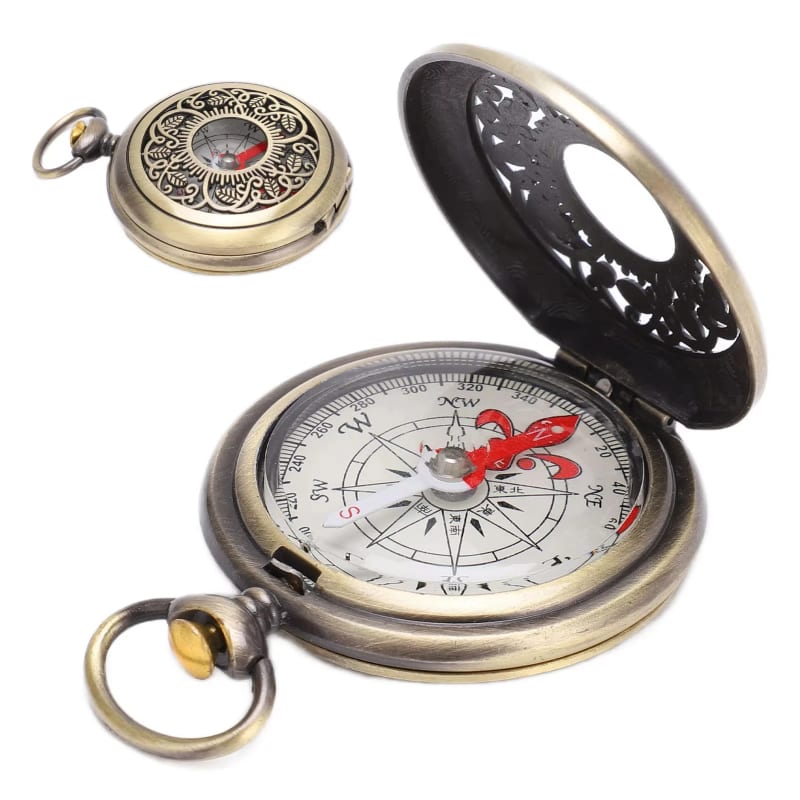
A pocket compass with a hinged cover is the direct descendant of those floating needles: a magnetised needle on a pivot, protected by a lid. Our guides explain how a compass works, how to use one, and why a compass can point the wrong way.
Frequently asked questions
Who invented the compass first?
The Chinese. They used lodestone direction-finders for divination first, then magnetised needles for navigation by the early 1100s. No individual inventor is known.
When was the compass invented?
Lodestone direction-finders are traditionally dated to the Han dynasty, about two thousand years ago. Needle compasses were described in China in 1088 and used at sea by the early 1100s.
Who invented the compass in Europe?
No one person. Alexander Neckam described sailors using one around 1190; the Amalfi inventor Flavio Gioia is a legend.
What was the compass first used for?
Divination and geomancy in China, including the placing of buildings and graves. Navigation came later.