How to Use a Compass: A Beginner's Guide
Nov 5, 2026 · The Editors
How a compass works, how to read one, how to find a direction and walk to it without a map, magnetic north versus true north, and the mistakes that throw a compass off.
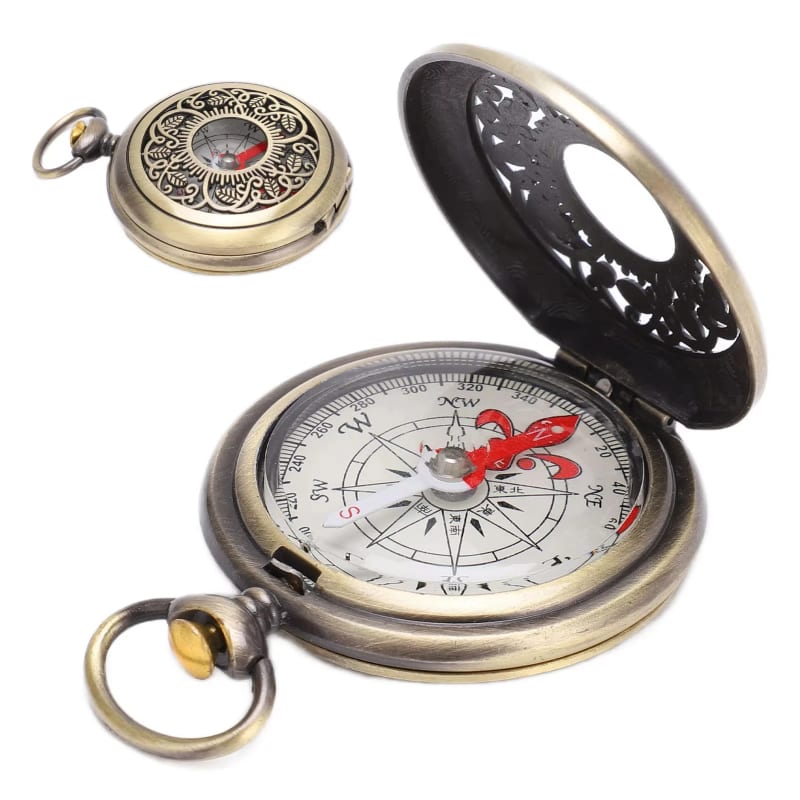
A compass is the simplest navigation tool there is: a magnetised needle that turns to point north, wherever you are. Knowing which way is north turns a strange street, a trail or a field into something you can find your way through. Here is how to read one.
How does a compass work?
The Earth behaves like a giant, weak magnet. A compass needle is a small magnet balanced on a pivot so it can turn freely, and it lines itself up with the Earth's magnetic field — one end pointing towards magnetic north. On almost every compass that end is painted red or marked N.
The parts of a compass
- The needle — the red (or marked) end points north.
- The dial, or compass rose — the directions N, E, S and W, often with the points in between and degree markings from 0 to 360.
- The housing — the case that holds it all and keeps the needle level.
How to read a compass
- Hold it flat and level in your palm, at about waist height. A tilted compass lets the needle drag.
- Keep still and wait a moment for the needle to settle.
- Turn the compass, not the needle, until the N on the dial sits under the red end of the needle.
- Now the dial is aligned. Every direction on it points the right way: east is to your right, south behind you, west to your left.
How to use a compass without a map
To head in a particular direction:
- Align the compass as above.
- Find the direction you want on the dial — say, north-east.
- Look along that line and pick a landmark directly ahead: a tree, a tower, a corner.
- Put the compass away and walk to the landmark, then repeat.
Walking from landmark to landmark keeps you straight; staring at the needle while you walk does not.
To retrace your steps, the way back is simply the opposite direction: if you walked north-east, return south-west.
Magnetic north and true north
A compass points to magnetic north, which is not quite the same as the North Pole (true north). The difference, called declination, depends on where you are — across the United States it ranges from almost nothing to more than ten degrees. For finding your bearings it rarely matters; for serious navigation with a map, you correct for it using the declination printed on the map.
Mistakes that throw a compass off
- Metal and magnets nearby. Phones, car bodies, steel railings, belt buckles and other magnets pull the needle. Step away from them before you take a reading.
- Holding it tilted. The needle catches on the housing.
- Following the needle instead of the landmark. You drift without knowing it.
- Storing it next to a magnet, which can weaken the needle over time.
A pocket compass for the desk or the trail
A pocket compass with a hinged cover is part instrument, part keepsake — the traveller's companion to a pocket watch. It is perfect for finding your bearings on a walk or in a new city. For real backcountry navigation, carry a proper baseplate compass and a map, and learn to use them together before you need to.
Mentioned above