How Does a Compass Work? Magnetic North, Declination and Dip
Nov 18, 2026 · The Editors
A compass works because its magnetised needle lines up with the Earth's magnetic field and points to magnetic north. How that works, why it is not true north, how a phone compass differs, and what stops a compass working.
A compass works because its needle is a small magnet, balanced so it can turn freely. The Earth itself behaves like a giant magnet, and the needle swings until it lines up with the Earth's magnetic field, so one end points towards magnetic north. Read the dial against the needle and you know which way you are facing.
The Earth as a magnet
Molten iron moving in the Earth's outer core generates a magnetic field. At the surface, that field runs roughly from the south of the planet to the north, much like the field around a bar magnet.
A compass needle is a thin piece of magnetised steel. Like any magnet, its north-seeking end is pulled towards the Earth's magnetic north and its south-seeking end the other way. The needle sits on a sharp pivot with almost no friction, so even the Earth's fairly weak field is enough to turn it.
A curiosity: because opposite poles attract, the place the needle's north end points to is, in physics terms, a magnetic south pole. The name stuck long before anyone knew.
Magnetic north is not true north
True north is the direction of the North Pole, the point the Earth spins around. Magnetic north is where the field points, and the two are not in the same place. The difference, seen from where you stand, is called magnetic declination (or variation).
| Where you are | What it means |
|---|---|
| on the line of zero declination | the needle points to true north |
| east or west of that line | the needle points a few degrees, sometimes many, to one side |
| near the magnetic pole | the compass becomes unreliable |
Declination changes from place to place and slowly over the years, because the magnetic pole moves. Maps used for navigation print the local declination so walkers can correct for it. Our guide to how to use a compass shows how.
Why a compass needle tilts (dip)
The Earth's field does not run flat along the ground; it dips down into the Earth, steeply near the poles. A free needle would tilt with it. Compass makers counterweight the needle so it sits level in the region where it will be used, which is why a compass bought in one hemisphere can drag or stick in the other. We explain this in does a compass work in the southern hemisphere.
How a phone compass works
A phone has no needle. It uses a tiny magnetometer, an electronic sensor that measures the strength and direction of the magnetic field, and software turns that into a heading. That is why a phone sometimes asks you to wave it in a figure of eight: it is calibrating the sensor against the magnets and metal inside the phone itself.
What stops a compass working
- Iron and steel nearby: a belt buckle, a car, a steel table.
- Magnets and electronics: speakers, phones, magnetic clasps.
- Being near the magnetic poles, where the field points almost straight down.
- A weakened needle, after years beside strong magnets.
A short history
The magnetic compass was first developed in China: by the eleventh century, Chinese writers described magnetised needles used to find direction, including at sea. European writers describe the compass from the late twelfth century. It changed navigation more than any tool before it, and its dial gave us the compass rose.
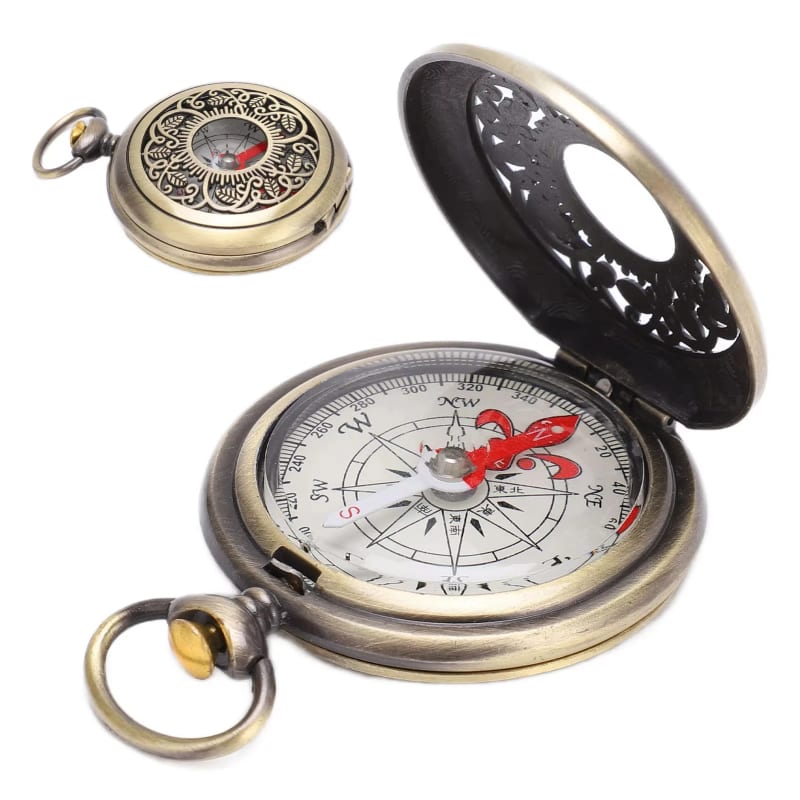
An antique bronze pocket compass uses the same principle in a case that closes like a pocket watch. For the symbolism, see compass gift meaning.
Frequently asked questions
How does a compass work, simply?
The needle is a magnet. The Earth is a giant magnet too, so the needle turns until it lines up with the Earth's magnetic field and points to magnetic north.
Does a compass point to true north?
No. It points to magnetic north. The angle between the two, called declination, depends on where you are and changes slowly over time.
How does a compass work on a phone?
A phone uses an electronic sensor called a magnetometer that measures the Earth's magnetic field, and software turns the reading into a direction.
What can make a compass wrong?
Nearby iron or steel, magnets, electronics, and being very close to the magnetic poles.