Stalemate in Chess: Meaning, Rules and Who Wins
Nov 10, 2026 · The Editors
What stalemate means in chess, why it is a draw rather than a win, stalemate vs checkmate, a clear example, the other ways a game is drawn, and how to avoid (or use) stalemate.
Stalemate happens when the player whose turn it is has no legal move and their king is not in check. The game ends immediately as a draw. Nobody wins, and in a scored game each player gets half a point.
It surprises beginners, because it usually happens when one side is far ahead and the other has only a king left. The winning side takes away every square the king could move to — and forgets to give check.
Stalemate vs checkmate
| Checkmate | Stalemate | |
|---|---|---|
| Is the king in check? | Yes | No |
| Any legal move? | No | No |
| Result | The side that delivered it wins | Draw |
The difference is one detail: whether the king is attacked right now. If it is, and nothing can get it out of check, that is checkmate. If it is not, but every possible move would put the king in check (and no other piece can move), that is stalemate.
A stalemate example
Black: king on a8, nothing else. White: king on b6 and queen on c7. Black to move.
The black king is not in check — the queen on c7 does not attack a8. But every square it could go to is covered: a7 and b7 by the queen and the white king, b8 by the queen. Black has no legal move, so the game is a stalemate and a draw. Had White played the queen to b7 instead (protected by the king), it would have been checkmate.
Stalemate rules: common questions
Who wins a stalemate in chess? Nobody. Under the official rules it is a draw.
Does stalemate need a lone king? No. It needs only that the side to move has no legal moves. A player whose pawns are all blocked and whose king is boxed in can be stalemated too.
How many moves is a stalemate? None — stalemate is not counted in moves. It is often confused with the fifty-move rule and threefold repetition, which are separate ways to draw.
Has it always been a draw? No. Before the rules were standardised in the 19th century, stalemate was treated differently in different places, and at times counted as a win for one side. Some players still argue it should be a win for the stronger side, but the draw is the rule everywhere today.
Other ways a chess game is drawn
| Draw | What happens |
|---|---|
| Stalemate | Side to move has no legal move and is not in check |
| Threefold repetition | The same position occurs three times with the same player to move; a player can claim a draw |
| Fifty-move rule | Fifty moves by each side with no capture and no pawn move; a player can claim a draw |
| Insufficient material | Neither side can possibly checkmate (for example, king against king) |
| Agreement | Both players agree to a draw |
How to avoid stalemate (and how to use it)
- When winning with a queen, check the enemy king's moves after every one of yours. Always leave it at least one square until you are ready to give mate.
- Bring your king up. Most basic mates need the king's help; it is safer than chasing with the queen alone.
- When losing, look for stalemate. Getting rid of your last movable pieces so your king has no moves can save a lost game.
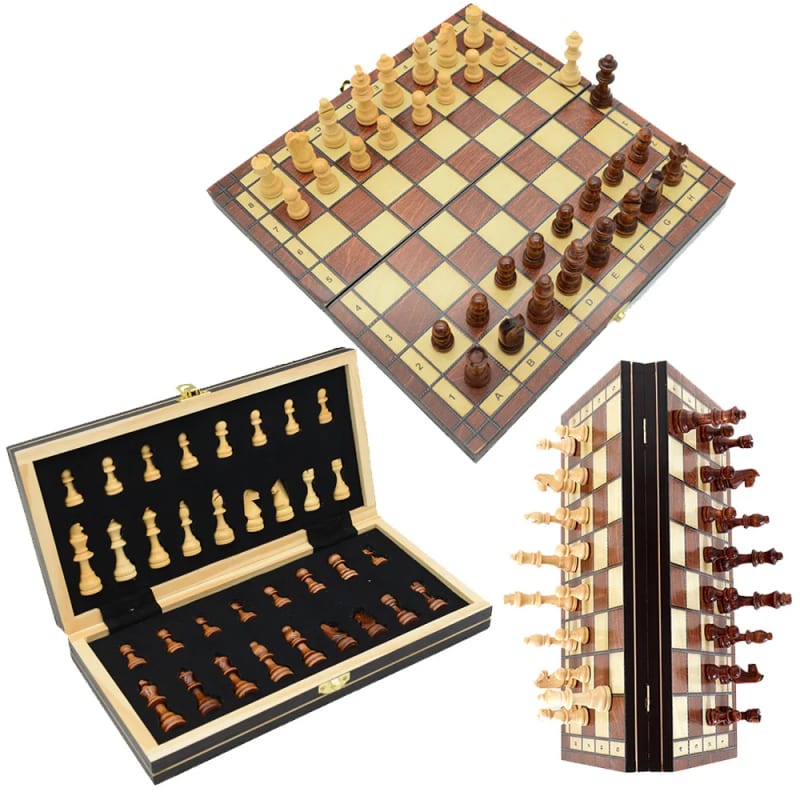
If you are still learning how each piece moves, start with our chess rules for beginners and how chess pieces move. Setting up these positions on a real board helps them stick — a three-in-one chess set also plays checkers and backgammon on the same board.