Chess Notation Explained: How to Read and Write Chess Moves
Nov 9, 2026 · The Editors
Chess notation explained for beginners: the board's coordinates, piece letters, captures, check and checkmate symbols, castling, promotion, the ! and ? marks, and how to keep a notation sheet.
Chess notation is how players write down a game so it can be replayed move by move. It looks like code at first — 1. e4 e5 2. Nf3 Nc6 — but there are only a few rules. Learn them and you can follow any chess book, record your own games and play through famous matches on your own board.
The board: files and ranks
Modern chess uses algebraic notation. Every square has a name made of a letter and a number.
- Files are the columns, lettered a to h from White's left to right.
- Ranks are the rows, numbered 1 to 8 from White's side to Black's.
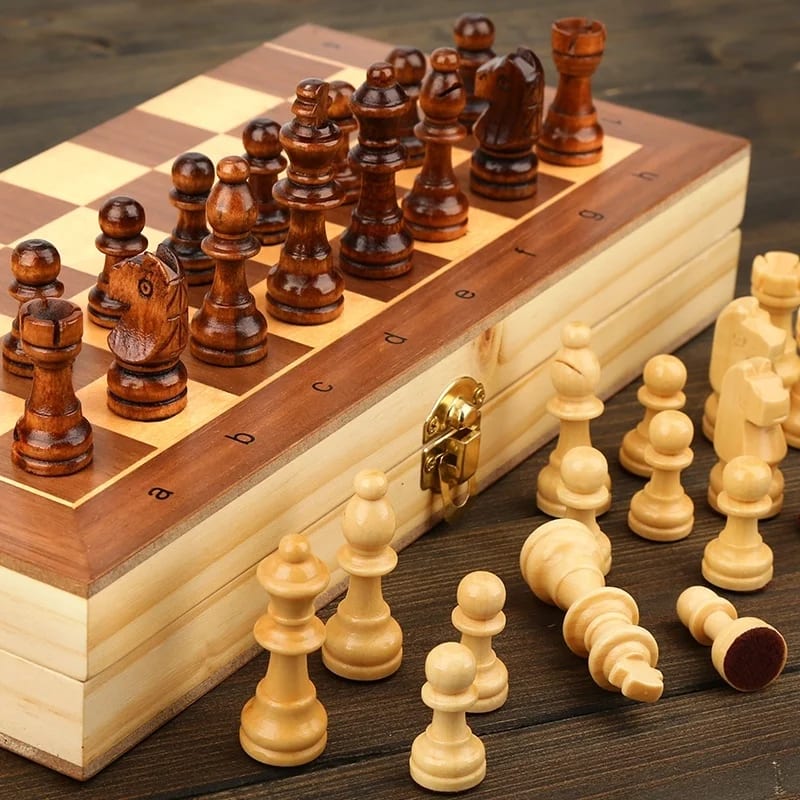
So White's king starts on e1, Black's queen on d8, and the square in the middle in front of White's king pawn is e4. If your board does not have letters and numbers printed on its edges, check that the light square is on each player's right — see how to set up a chess board.
Chess notation for each piece
| Piece | Letter |
|---|---|
| King | K |
| Queen | Q |
| Rook | R |
| Bishop | B |
| Knight | N (K is taken by the king) |
| Pawn | no letter |
A move is written as the piece letter plus the square it moves to. Nf3 means a knight moves to f3. e4 means a pawn moves to e4.
Chess notation symbols
| Symbol | Meaning | Example |
|---|---|---|
| x | Capture | Bxe5 (bishop takes on e5); exd5 (pawn on the e-file takes on d5) |
| + | Check | Qh5+ |
| # | Checkmate | Qf7# |
| O-O | Castling kingside | |
| O-O-O | Castling queenside | |
| = | Pawn promotion | e8=Q |
| e.p. | En passant (optional) | exd6 e.p. |
The chess notation for checkmate is #, though some older books use ++. A game result is written 1-0 (White wins), 0-1 (Black wins) or ½-½ (draw).
When two pieces could make the same move
If two knights could both reach d2, add the file (or rank, if the file is the same) the moving piece came from: Nbd2 means the knight on the b-file goes to d2; R1e2 means the rook on the first rank goes to e2.
How moves are numbered
A move number covers one move by White and one by Black:
- e4 e5
- Nf3 Nc6
- Bb5 a6
If a commentary starts with a Black move, it is written with dots: 3... a6.
The ! and ? marks
Commentators add marks after a move: ! a good move, !! a brilliant one, ? a mistake, ?? a blunder, !? interesting, ?! dubious. You do not write these during a game — they are for analysis afterwards.
Keeping a chess notation sheet
In most over-the-board tournaments, players must write down every move on a notation sheet (scoresheet) as they play, which also settles disputes about repetition and the clock. Rules usually let a player stop writing when very short of time. Write your move, then make it, then press your clock — or follow your event's order if it says otherwise.
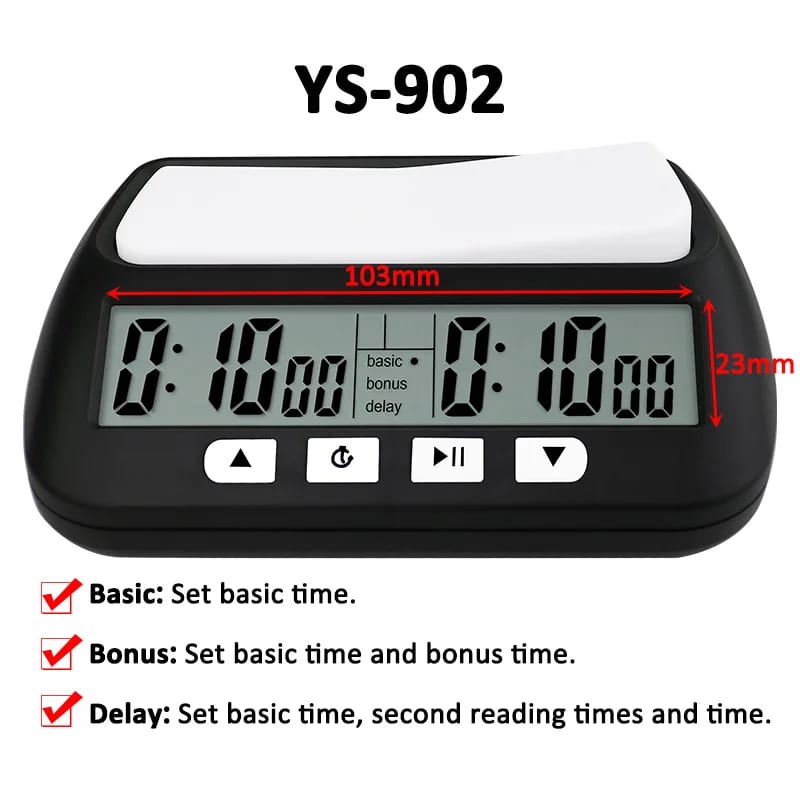
Practising at home is the best way to learn: play a game with a friend, record it, and replay it the next day. A digital chess clock makes home games feel like the real thing; our chess clock rules explain how to use one. You will also see the notation in action in chess openings for beginners.
Descriptive notation: the old style
Older English books use descriptive notation, where squares are named from each player's own side (P-K4 for 1. e4). It is no longer used officially, but if you inherit an old chess book, that is what you are reading.