Quill vs Dip Pen vs Fountain Pen: What's the Difference?
Nov 23, 2026 · The Editors
A quill is a cut feather, a dip pen has a metal nib you dip in ink, and a fountain pen carries its own ink. How they differ, how they write, and which to choose.
In this guide
Shopping for Christmas? Order by Saturday, December 5. Our items ship from our supplier and most arrive within two weeks.
The difference is where the ink lives and what the tip is made of. A quill is a feather whose hollow shaft is cut to a point and dipped in ink. A dip pen has a metal nib on a holder and is also dipped. A fountain pen carries its own ink inside and feeds it to the nib, so you never dip. Most "quill pens" sold today are really a feather holder with a metal dip-pen nib.
The three pens at a glance
| Quill | Dip pen | Fountain pen | |
|---|---|---|---|
| Tip | Cut feather | Steel (or gold) nib | Steel or gold nib |
| Ink | Dip every few words | Dip every line or so | Built-in reservoir |
| Ink types | Iron gall, India, calligraphy | Almost any, including thick inks | Only fountain-pen ink |
| Line variation | Good | Excellent, especially flexible nibs | Limited on most nibs |
| Upkeep | Recut the tip often | Wipe and change nibs | Flush and refill |
| Era | Roughly 6th to 19th century | 19th century onward | Late 19th century onward |
The quill
From late antiquity until the nineteenth century, most writing in Europe was done with quills, usually goose feathers, cut with a small knife (the origin of the word penknife). A cut quill writes beautifully but wears quickly and needs recutting. Our quill pen history tells the full story.
The dip pen
In the early nineteenth century, factories in Birmingham, England began mass-producing steel nibs, and within a few decades they replaced the quill almost everywhere. A steel nib holds its shape far longer than a feather. Dip pens are still the tool of choice for calligraphers and comic artists, because they take inks a fountain pen cannot, and a flexible nib swells and thins a line with pressure.
How to use a quill pen with a metal nib
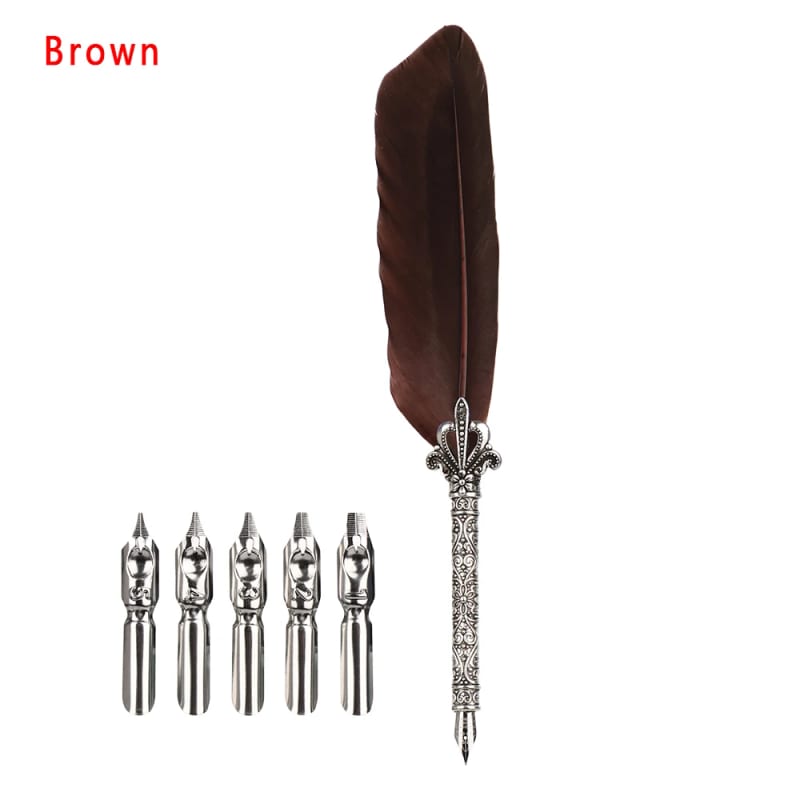
A feather pen with a metal nib, like our feather quill pen with five nibs, is a dip pen in a quill's clothes:
- Clean a new nib. Nibs come with a protective oil; wipe it off with a little warm soapy water or rubbing alcohol so ink sticks.
- Dip to just past the vent hole, not up to the holder.
- Hold it at about 45 degrees and pull the nib towards you; never push it up the page.
- Light pressure for thin lines, a little more on down-strokes for thick ones.
- Wipe the nib when you finish so it does not rust.
Use dip-pen or calligraphy ink. Our how to write with a quill pen goes into more detail, and calligraphy for beginners covers letterforms.
The fountain pen
Fountain pens became practical in the late nineteenth century, once makers solved the problem of ink flowing evenly rather than blotting. They are the most convenient of the three for everyday writing. The trade-off is that they need thin, free-flowing fountain-pen ink; thick India or calligraphy inks clog them.
Which should you choose?
- For everyday writing: a fountain pen.
- For calligraphy, wedding cards and art: a dip pen, for the widest range of inks and nibs.
- For atmosphere, signatures and gifts: a feather quill with metal nibs, which writes like a dip pen and looks like history on the desk.
Frequently asked questions
Is a quill pen the same as a dip pen?
A true quill is a cut feather; a dip pen has a metal nib. Most modern quill pens fit a metal nib to a feather, so they write like a dip pen.
Can you use fountain pen ink in a quill?
Yes, though it is thin and may bleed on some papers. Dip-pen or calligraphy ink usually gives crisper lines.
Can you put calligraphy ink in a fountain pen?
Usually not. Thick, pigmented calligraphy and India inks can clog a fountain pen's feed.
When did people stop using quills?
Steel nibs replaced quills over the course of the nineteenth century, once factories could make them cheaply.