Quill Pen History: Who Invented It, and Why It Disappeared
Nov 23, 2026 · The Editors
The history of the quill pen: from reed pens to goose feathers, how quills were cut and cured, the penknife, and why steel nibs replaced them in the nineteenth century.
In this guide
Shopping for Christmas? Order by Saturday, December 5. Our items ship from our supplier and most arrive within two weeks.
Nobody is known to have invented the quill pen. Feather pens came into use in Europe in late antiquity, replacing the reed pen, and the earliest clear written reference is usually dated to the seventh century. Quills remained the main writing tool in the West for over a thousand years, until mass-produced steel nibs replaced them in the nineteenth century.
Before the quill: the reed pen
The ancient world wrote with reed pens: a hollow reed cut to a point. Reeds suited papyrus. As parchment and vellum, made from animal skin, replaced papyrus in Europe, writers turned to the feather, which could be cut to a finer, more flexible point and lasted longer.
The word pen itself comes from the Latin penna, meaning feather.
Which feathers made the best quills?
| Feather | Use |
|---|---|
| Goose | The everyday quill: plentiful, strong, good all-round |
| Swan | Prized, larger and longer-lasting, more expensive |
| Crow | Very fine lines, for detailed drawing |
| Turkey | Used in the Americas; tough |
The strongest quills came from the flight feathers of the wing. It is often said that right-handed writers preferred feathers from a bird's left wing, because they curve away from the writer's hand.
How a quill was made
A raw feather is too soft to write with. Making a quill took several steps:
- Cure the feather, traditionally by heating it, for example in hot sand, which hardened the shaft and made it clear.
- Strip some of the barbs so the hand can grip the shaft. The elegant full-feather quill of films is mostly decoration.
- Cut the nib with a small, sharp knife: a slanting cut, a slit up the middle to carry the ink, and a final trim.
That small knife is why a folding pocket knife is still called a penknife. A writer recut the nib often, sometimes several times a day.
The quill's long reign
For more than a thousand years, almost everything written by hand in Europe and the Americas was written with a quill: medieval manuscripts, letters, account books, early scientific notebooks and the founding documents of many nations. Monastic scribes, clerks and schoolmasters all carried a penknife to keep their quills sharp.
Why the quill disappeared
Quills wore out quickly and had to be recut, and a busy office could use a great many. In the early nineteenth century, factories, especially in Birmingham, England, began making steel nibs in vast numbers. They were cheap, consistent and needed no cutting. By the middle of the century steel dip pens had largely replaced quills, and fountain pens later replaced dip pens.
Writing with a quill today
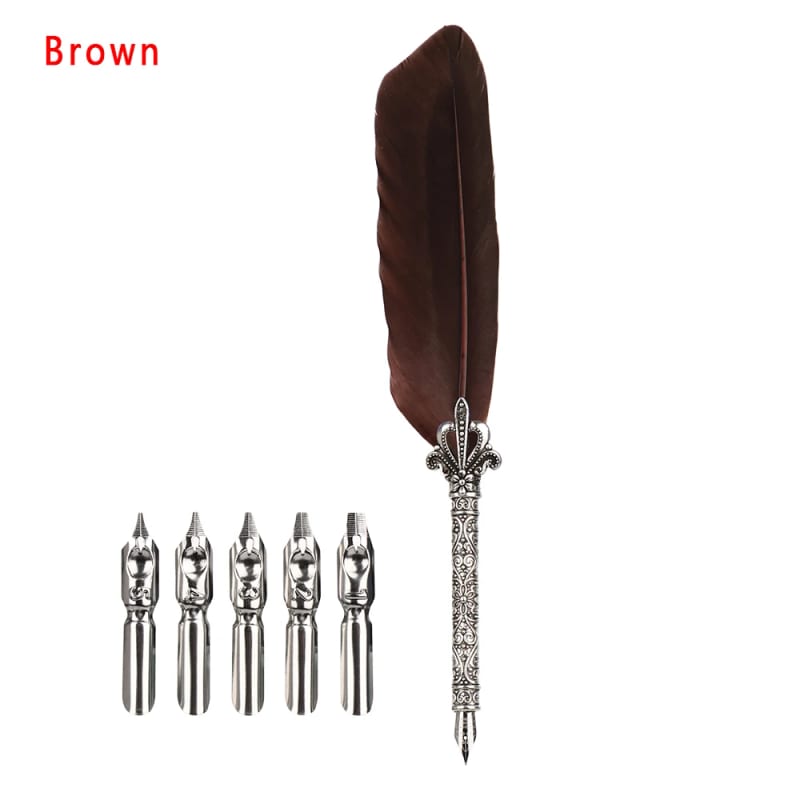
Quills are still used by calligraphers, historical re-enactors and anyone who enjoys a slower, more deliberate kind of writing. Many modern quills, including ours, fit a metal nib into the feather's shaft, which gives the look of a quill with the convenience of a steel point.
Our feather quill pen comes with five nibs for different line widths. To use one, see how to write with a quill pen, and for lettering, calligraphy for beginners. For more gift ideas around the writing desk, see gifts for writers.
Frequently asked questions
Who invented the quill pen?
No single inventor is known. Feather pens came into use in late antiquity, and the earliest clear reference is usually dated to the seventh century.
When did people stop using quill pens?
During the nineteenth century, when cheap mass-produced steel nibs replaced them. By the middle of that century quills were rare.
What feathers were used for quill pens?
Mostly goose flight feathers. Swan feathers were prized, and crow feathers were used for very fine lines.
Why is it called a penknife?
Because the small folding knife was originally used to cut and sharpen quill pens.