How to Read Runes for Beginners: Casting and Spreads
Nov 9, 2026 · The Editors
How to read runes for beginners: preparing a question, drawing a single rune, three-rune and five-rune spreads, casting runes on a cloth, reversed (merkstave) runes, and reading for yourself or someone else.
Runes were an alphabet before they were anything else. The Elder Futhark — 24 letters carved in wood, bone and stone across northern Europe from about the 2nd century — was used to write names, memorials and charms. Reading them as an oracle, the way many people do today, is largely a modern practice built on those old letters and the Norse myths around them. Approached that way, as a tool for reflection, it is a rewarding one. Here is how to start.
Before you begin
- Learn a few runes first. You do not need all 24 memorised. Read through the meanings in Elder Futhark runes and their meanings, and look up the rest as you draw them.
- Frame a clear question. "What do I need to understand about this job offer?" works far better than "Will my life get better?" Open questions suit runes; yes-or-no questions are better answered by a coin.
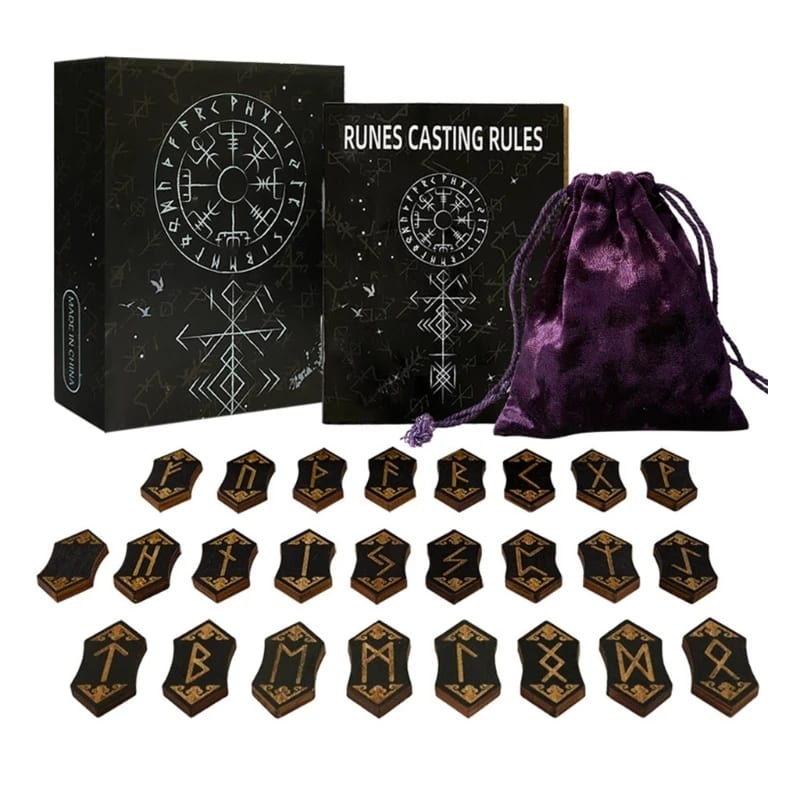
- Keep the runes in a bag. Drawing blind from a bag is the simplest way to choose them.
The single rune draw
Hold your question in mind, reach into the bag, and take one rune. Read its meaning as advice on the question, not a prediction. Many people draw one rune each morning as a theme for the day — the fastest way to learn the whole set.
The three-rune spread
Draw three runes and lay them left to right. Two common ways to read them:
| Position | Past, present, future | Situation, action, outcome |
|---|---|---|
| First rune | what led here | the situation as it is |
| Second rune | where you stand now | what you can do |
| Third rune | where this is heading | the likely result |
A version named after the three Norns of Norse myth — Urd, Verdandi and Skuld, who tend the roots of the world tree — reads the three as what was, what is becoming and what shall be.
The five-rune cross
Lay one rune in the centre, then one to the left, one to the right, one above and one below.
- Centre: the heart of the matter.
- Left: influences from the past.
- Right: what lies ahead.
- Below: what is beneath the surface or holding you back.
- Above: help available to you, or the best possible outcome.
How to cast runes on a cloth
Casting is the older-feeling method. Lay a cloth on the table — white is traditional — hold a handful of runes, or the whole bag, and scatter them across it.
- Read only the runes that land face up.
- Runes near the centre speak most directly to the question; those near the edge are background.
- Runes that land touching or overlapping are read together.
- Ignore any that fall off the cloth.
The Roman historian Tacitus, writing around the year 98, describes Germanic peoples cutting a branch into slips, marking them with signs and scattering them on a white cloth to be read. Whether those signs were runes, nobody knows — but it is the image most rune casters have in mind.
Reversed runes (merkstave)
When a rune lands upside down, many readers call it merkstave and read a blocked or reversed version of its meaning: Fehu, wealth, reversed becomes loss or greed. See Fehu rune meaning for an example.
About nine runes look the same either way up — Gebo, Hagalaz, Naudiz, Isa, Jera, Eihwaz, Sowilo, Ingwaz and Dagaz — so they cannot be reversed. Some readers ignore reversals altogether and read every rune upright. Either is fine; choose one and stay consistent.
The blank rune
Some sets include a 25th, blank rune, often called Wyrd or Odin's rune. It was introduced in a popular book in the 1980s and has no basis in the historical futhark. Many readers leave it out; traditional sets of 24 do not include it.
How to cast runes for yourself and for someone else
For yourself, the hardest part is honesty: it is tempting to read the meaning you hoped for. Write down the question and the runes before you interpret them, and read the note again a week later.
For someone else, let them hold the question and draw or cast the runes themselves. Explain each rune's meaning, then ask what it brings to mind for them — their own interpretation is usually more useful than yours.
Getting a set
A good first set has all 24 runes clearly marked and a bag to draw them from. Our Elder Futhark rune set is 24 wooden runes in gold on dark wood, with a velvet bag, a box and a printed casting guide. Readers who already use tarot often keep both — see tarot spreads for beginners — and the Algiz rune is a good one to read about next.
Mentioned above