Elder Futhark Runes and Their Meanings: All 24, Explained
Nov 4, 2026 · The Editors
The 24 runes of the Elder Futhark with their names and meanings, where the alphabet comes from, why Viking runes are a different set, and how to cast runes.
Runes were the letters of the early Germanic peoples, carved into wood, bone, metal and stone across Scandinavia and northern Europe. The oldest runic alphabet, the Elder Futhark, has 24 runes, and each has a name that is also a word — cattle, ice, sun, journey — which is where the meanings come from.
What "futhark" means
The name is simply the first six letters: F, U, Th, A, R, K, the way "alphabet" comes from alpha and beta. The oldest inscriptions in it date from around the 2nd century AD.
Elder Futhark vs Viking runes
A common mix-up: the Vikings did not use the Elder Futhark. By the Viking Age, from about AD 800, Scandinavians had simplified it into the Younger Futhark of just 16 runes. The Elder Futhark is several centuries older. In England, a longer variant grew into the Anglo-Saxon futhorc. Today the Elder Futhark is the set most often used for rune casting, and the one in our set.
A note on the meanings
No one wrote down what the Elder Futhark names meant while it was in use. The names below are scholarly reconstructions, built from later rune poems in Old English, Old Norwegian and Old Icelandic. They are well grounded — but where a meaning is uncertain, it is marked as such.
The 24 runes and their meanings
The runes are traditionally grouped into three ættir ("families") of eight.
Freyr's ætt
- Fehu — cattle, wealth. Prosperity earned and shared.
- Uruz — the aurochs, a great wild ox. Strength and endurance.
- Thurisaz — a giant, or a thorn. Force, danger, defence.
- Ansuz — a god, associated with Odin. Speech, wisdom, inspiration.
- Raidho — riding, a journey. Movement, direction, travel.
- Kenaz — a torch. Knowledge, skill, creativity.
- Gebo — a gift. Generosity and exchange.
- Wunjo — joy. Harmony, contentment.
Hagal's ætt
- Hagalaz — hail. Sudden disruption from outside.
- Nauthiz — need. Hardship, constraint, necessity.
- Isa — ice. Stillness, a standstill.
- Jera — the year, harvest. Reward that comes in its season.
- Eihwaz — the yew tree. Endurance, the link between life and death.
- Perthro — uncertain; often read as a lot-cup for casting. Chance, mystery.
- Algiz — an elk, or protection. Defence, sanctuary.
- Sowilo — the sun. Success, energy, victory.
Tyr's ætt
- Tiwaz — the god Tyr. Justice, courage, sacrifice.
- Berkano — the birch. Growth, new beginnings, birth.
- Ehwaz — the horse. Partnership, trust, progress.
- Mannaz — man, humankind. The self, community.
- Laguz — water, a lake. Flow, intuition.
- Ingwaz — the god Ing. Potential, gestation, completion.
- Dagaz — day. Breakthrough, dawn, clarity.
- Othala — inherited land. Heritage, home, belonging.
(The last two appear in either order in different inscriptions.)
How to cast runes
Rune casting as it is practised today is a modern tradition, built on old sources. The Roman historian Tacitus described Germanic people choosing marked slips of wood at random and reading three of them — though he does not say the marks were runes. Most people today use one of these:
- One rune — draw a single rune from the bag for the day, or for a question.
- Three runes — draw three and lay them left to right: the situation, the challenge, the likely outcome. Or past, present, future.
- Casting — hold the runes, think of your question, and scatter them on a cloth. Read the ones that land face up, nearest the centre first.
Many readers also read a rune drawn upside down (merkstave) as its meaning blocked or reversed. That is a modern convention, and optional.
Like tarot, runes work best as a way to think a question through, not as a forecast.
Our rune set
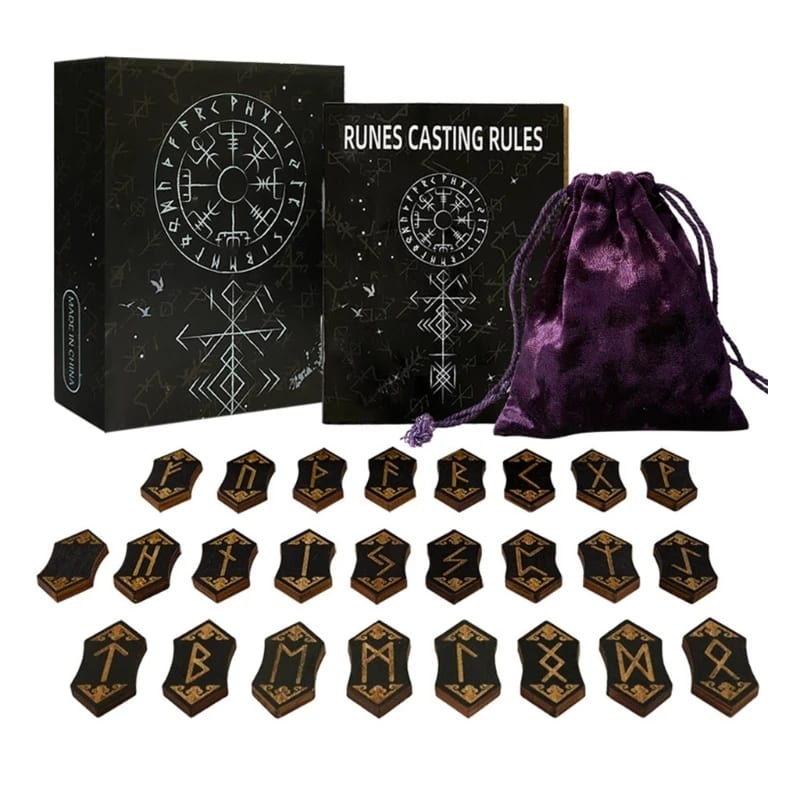
Our Elder Futhark set has all 24 runes in gold on dark wooden tiles, with a drawstring bag to draw them from, a box, and a printed casting guide. It makes a good gift for anyone who reads Norse myth, plays tabletop games, or likes old alphabets.
Mentioned above