How Do Chess Pieces Move? A Piece-by-Piece Guide
Nov 7, 2026 · The Editors
How each chess piece moves and captures, piece by piece: the king, queen, rook, bishop, knight and pawn, with their special moves, their point values, and tips for using each well.
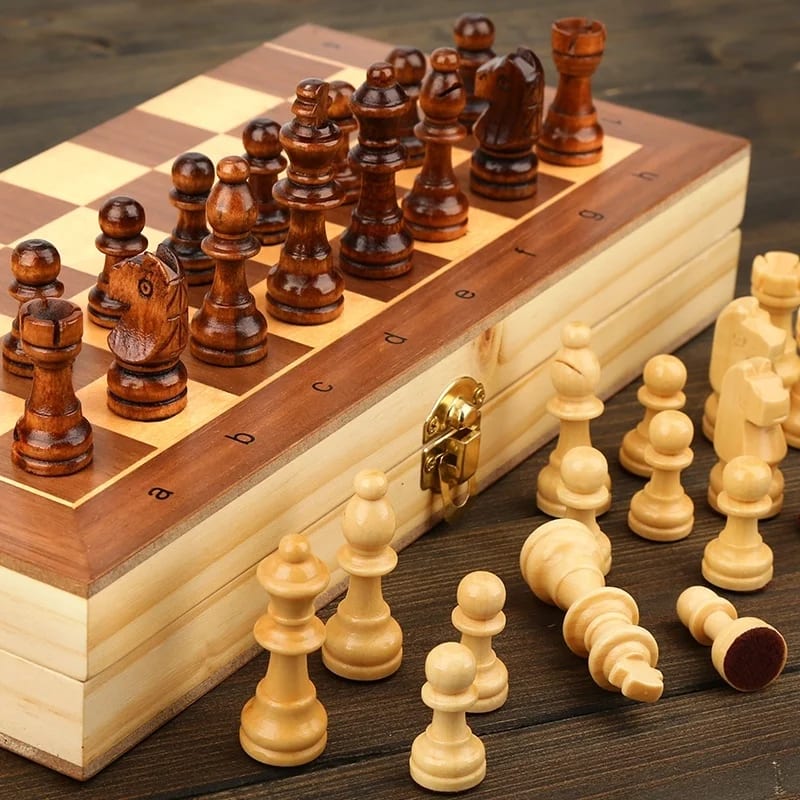
Each of the six chess pieces moves in its own way. All of them except the Knight are blocked by any piece in their path, and all of them capture by moving onto an enemy piece's square. Here is each one.
The King
- Moves: one square in any direction.
- Special: castling — once per game, the King moves two squares towards a Rook, and the Rook jumps over to the other side of it. The castling rules.
- Limit: it can never move onto a square where it would be in check.
- Value: priceless — lose it and you lose the game.
The King is weak in the opening and middlegame — keep it safe, usually by castling — and becomes a strong attacking piece in the endgame, when the board has emptied.
The Queen
- Moves: any number of squares in a straight line — horizontally, vertically or diagonally.
- Value: 9 points.
The most powerful piece: it combines the Rook and the Bishop. Beginners often bring it out too early, where it gets chased around by smaller pieces.
The Rook
- Moves: any number of squares horizontally or vertically.
- Value: 5 points.
Rooks are strongest on open files — columns with no pawns — and on the opponent's second row. Two Rooks working together are formidable.
The Bishop
- Moves: any number of squares diagonally.
- Value: 3 points.
Each Bishop stays on the colour it starts on for the whole game. The pair of Bishops together is usually stronger than a Bishop and Knight.
The Knight
- Moves: in an L-shape: two squares in one direction, then one square at a right angle. Or one square, then two.
- Special: the only piece that jumps over other pieces.
- Value: 3 points.
A Knight always lands on a square of the opposite colour to the one it left. It is strongest in the centre — "a Knight on the rim is dim" — and in closed positions full of pawns.
The Pawn
- Moves: forward one square. On its very first move, it may move two squares.
- Captures: one square diagonally forward — not straight ahead. A pawn blocked by a piece directly in front of it cannot move.
- Special:
- En passant — a pawn that moves two squares and lands beside an enemy pawn can be captured as if it had moved one.
- Promotion — a pawn reaching the far side becomes a Queen, Rook, Bishop or Knight.
- Value: 1 point.
Pawns never move backwards. "Pawns are the soul of chess," said the 18th-century master Philidor: their structure decides the shape of the whole game.
Point values at a glance
| Piece | Points |
|---|---|
| Pawn | 1 |
| Knight | 3 |
| Bishop | 3 |
| Rook | 5 |
| Queen | 9 |
| King | — |
Use these to judge trades: giving up a Knight (3) for a Rook (5) wins "the exchange".
Next
How to set up the board · The full rules, including check, checkmate and draws.