Poker Tournament Blind Structure for a Home Game
Nov 12, 2026 · The Editors
A home poker tournament blind structure that works: starting stacks, blind levels and level times, a ready-made schedule for a two- to four-hour game, when to add antes and colour up chips, and how to size it for your table.

A good poker tournament blind structure starts every player with about 100 to 200 big blinds, raises the blinds every 15 to 20 minutes, and increases each level by roughly 25 to 50 percent. For a home game of 6 to 10 players, a 10,000-chip starting stack with blinds starting at 25/50 and 15-minute levels finishes in about three hours.
Choosing the starting stack
The starting stack sets how much play there is before the blinds bite. Measure it in big blinds:
| Starting stack | Feel |
|---|---|
| 50 big blinds | Fast, aggressive, lots of all-ins |
| 100 big blinds | A good home standard |
| 200 big blinds | Deep, slower, more post-flop play |
The chip numbers themselves do not matter; only the ratio to the blinds does. Most home games use 5,000 or 10,000. See how many poker chips per player for how to make up a stack.
Level length
- 10–12 minutes: a quick game, done in about two hours.
- 15 minutes: the home standard.
- 20–30 minutes: a slower, deeper game.
A ready-made home blind structure
For a 10,000 starting stack and 15-minute levels:
| Level | Small blind | Big blind |
|---|---|---|
| 1 | 25 | 50 |
| 2 | 50 | 100 |
| 3 | 75 | 150 |
| 4 | 100 | 200 |
| 5 | 150 | 300 |
| Break | Colour up the 25s | |
| 6 | 200 | 400 |
| 7 | 300 | 600 |
| 8 | 400 | 800 |
| 9 | 500 | 1,000 |
| 10 | 700 | 1,400 |
| 11 | 1,000 | 2,000 |
| 12 | 1,500 | 3,000 |
| 13 | 2,000 | 4,000 |
With 8 players, this usually ends somewhere between levels 10 and 13. For a 5,000 stack, halve every number, or start at 25/50 and use 10-minute levels for a short game.
How long will the tournament last?
A rough guide: the game tends to end when the big blind reaches about 5 percent of all the chips in play. With 8 players and 10,000 each (80,000 in total), that is a big blind around 4,000 — level 13 in the table above, a little over three hours including a break.
To shorten the game, use shorter levels or a smaller starting stack. To lengthen it, do the opposite. Avoid big jumps late in the structure; they turn the final hour into a lottery.
Antes
Many home tournaments never use antes. If you want them, add a big blind ante from about level 6: the big blind posts one ante for the whole table, usually equal to the big blind. It speeds the game up and is easy to track.
Colouring up
When the smallest chip is no longer needed — after the blinds pass 100/200 in the table above — take a short break to colour up: swap the small chips for larger ones. Count each player's small chips, exchange full sets, and settle odd amounts by agreed rounding.
Running it smoothly
- Use a phone timer and announce each new level.
- Move the dealer and blind buttons every hand so nobody argues about who posts.
- Write the blind schedule on a card and leave it on the table.
- Agree how players rebuy, if at all, before the first hand.
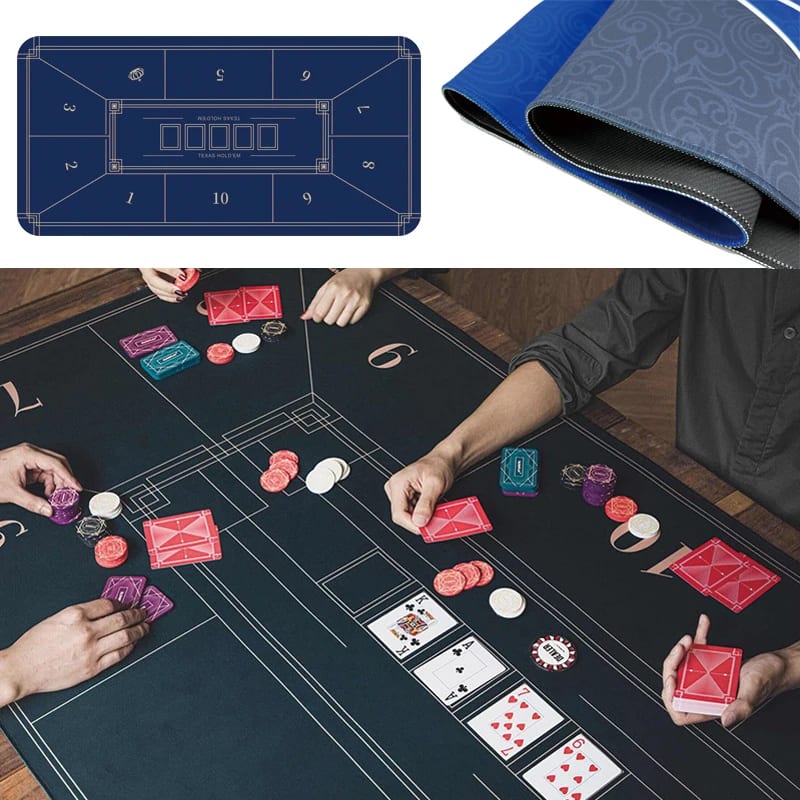
A large eight-player table topper gives a full tournament table room for stacks. For running the whole evening, see how to host a poker night, small blind, big blind and dealer button and poker chip values and colors.
Frequently asked questions
What is a good blind structure for a home poker tournament?
Start with 100 to 200 big blinds per player and raise the blinds every 15 to 20 minutes by 25 to 50 percent. A 10,000 stack starting at 25/50 is a good default.
How often should blinds go up in a home game?
Every 15 minutes is the home standard. Use 10 minutes for a quick game or 20 to 30 for a deep one.
How many chips should each player start with?
Most home tournaments use 5,000 or 10,000. What matters is the stack measured in big blinds, ideally 100 or more.
When should you add antes?
Optional at home. If you use them, add a big blind ante around the middle of the structure.