Peking Opera Face Paint: What Each Color Means
Nov 7, 2026 · The Editors
What the colors of Peking opera face painting mean: red, black, white, blue, green, yellow, purple, gold and silver, with famous characters for each, the four role types, and why the faces are painted, not masked.
In Peking opera — jīngjù, Beijing's great theatrical tradition — many characters wear their personality on their face. The bold painted designs, called liǎnpǔ, tell an audience at a glance who is loyal, who is cunning and who is not quite human.
Painted, not masked
Peking opera faces are often called masks, but they are painted directly onto the performer's face with make-up. The design for each famous character is fixed by tradition, and a performer may spend an hour or more applying it. Real masks are used in other Chinese theatre and in some rituals, but not in classic Peking opera.
What each colour means
| Colour | Meaning | Famous character |
|---|---|---|
| Red | Loyalty, courage, uprightness | Guan Yu, the loyal general |
| Black | Integrity, impartiality, boldness; sometimes roughness | Judge Bao; Zhang Fei |
| White | Treachery, cunning, suspicion | Cao Cao, the scheming warlord |
| Blue | Stubbornness, fierceness, bravery | Dou Erdun, the outlaw |
| Green | Impulsiveness, violence; heroic outlaws | Rebels and bandits |
| Yellow | Ferocity, ambition, cunning | Fierce warriors |
| Purple | Solemnity, justice, refinement | Upright nobles |
| Gold and silver | Gods, immortals, spirits and demons | The Monkey King, deities |
The amount of colour matters too. A face that is mostly white, with only a little colour, belongs to a deeply untrustworthy character. A small patch of white on the nose marks a clown.
The four role types
Every Peking opera role belongs to one of four types:
- Shēng — male roles: scholars, officials, young lovers, warriors. Make-up is natural.
- Dàn — female roles, traditionally played by men until the 20th century.
- Jìng — the painted-face roles: generals, heroes, villains, gods. Forceful, larger than life. Almost all the famous painted faces belong here.
- Chǒu — clowns, with the white patch on the nose. Often the wisest people on stage.
Where the colours come from
Peking opera took its form in Beijing in the late 18th and 19th centuries, and many of its stories come from older novels such as Romance of the Three Kingdoms. Audiences sat in noisy, crowded teahouses; the colours and patterns let everyone, however far from the stage, read the characters instantly.
Peking opera faces on playing cards
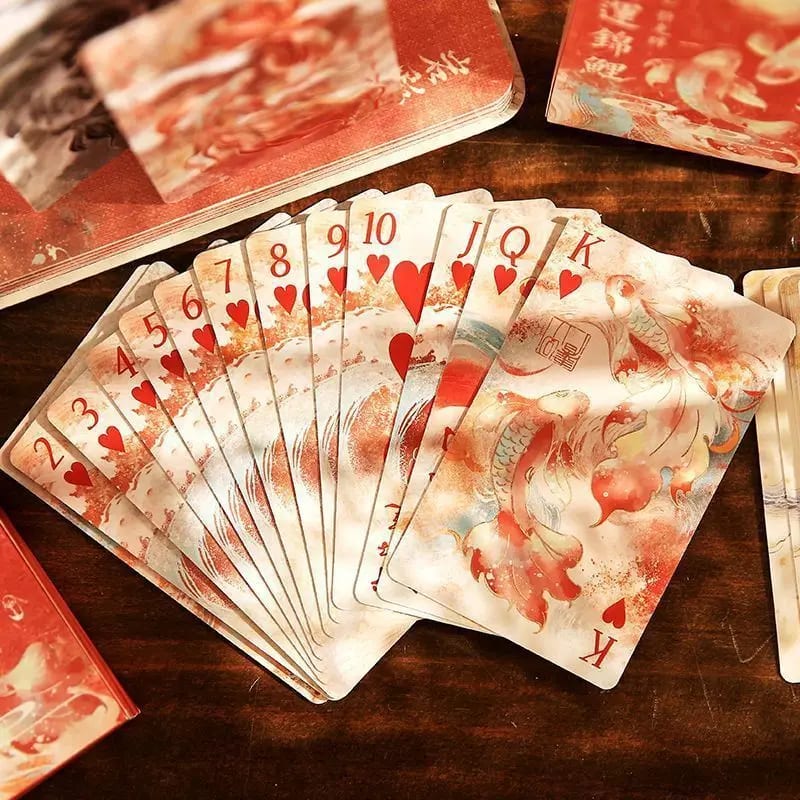
The painted faces are one of the most recognisable images of Chinese culture, and they have long decorated fans, porcelain, posters — and playing cards. A deck with opera faces on the court cards turns every King, Queen and Jack into a character from the stage. The history of Chinese playing cards.
A gift with a story
Opera faces make a striking gift for anyone who loves China, theatre or design — and a deck of cards with the faces on it is both something to play with and something to display.