Mahjong Tiles Meaning: Every Tile Explained in English
Nov 7, 2026 · The Editors
What mahjong tiles mean, in English: the three suits (dots, bamboo and characters), the winds and dragons, flowers and seasons, the Chinese characters on each, how many of each, and how to read the numbers.
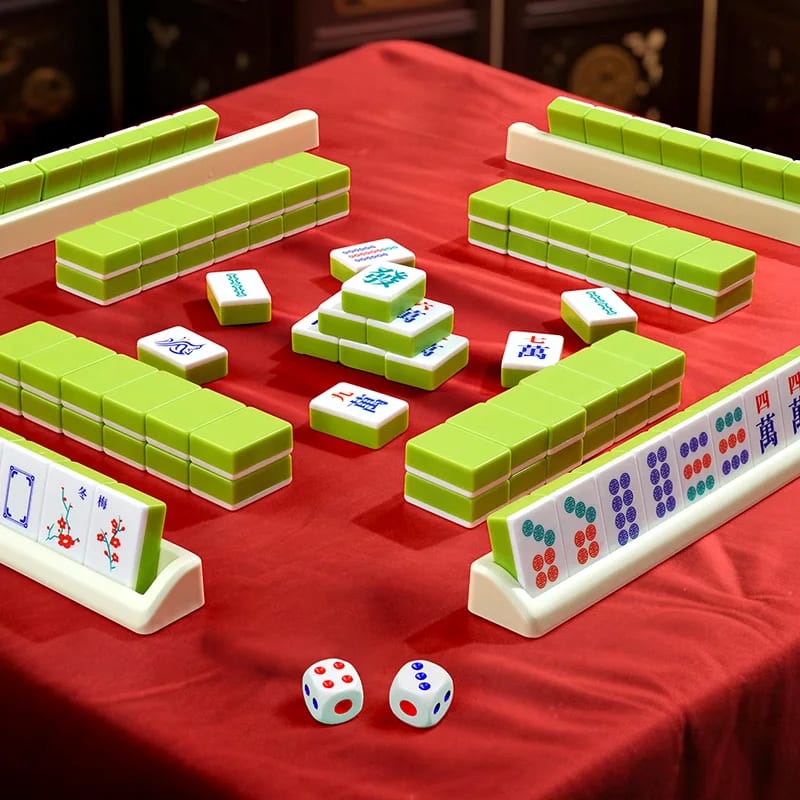
A Chinese mahjong set has 144 tiles. Once you know the six groups they belong to, the whole set reads easily — even without knowing Chinese.
The 144 tiles at a glance
| Group | Tiles | Copies | Total |
|---|---|---|---|
| Dots (circles) | 1–9 | 4 each | 36 |
| Bamboo (bams) | 1–9 | 4 each | 36 |
| Characters (cracks) | 1–9 | 4 each | 36 |
| Winds | East, South, West, North | 4 each | 16 |
| Dragons | Red, Green, White | 4 each | 12 |
| Flowers | 4 | 1 each | 4 |
| Seasons | 4 | 1 each | 4 |
| Total | 144 |
American mahjong sets add jokers, usually eight, for 152.
The three suits
The suits come from money, just as early Chinese playing cards did:
Dots (circles, 筒 tǒng). Each circle represents a coin. Count the circles to read the number: 1 dot is one large circle, 9 dots is nine.
Bamboo (bams, 条 tiáo or 索 suǒ). Each stick is a string of coins. Count the sticks — except the 1 of bamboo, which shows a bird, usually a sparrow or peacock. Beginners often mistake it for a flower.
Characters (cracks, 萬 wàn). Each tile has the red character 萬, meaning ten thousand, under a number written in Chinese. Learn the nine numbers:
| Number | Character |
|---|---|
| 1 | 一 |
| 2 | 二 |
| 3 | 三 |
| 4 | 四 |
| 5 | 五 |
| 6 | 六 |
| 7 | 七 |
| 8 | 八 |
| 9 | 九 |
The honours: winds and dragons
Winds. Four winds, written in Chinese:
- 東 East
- 南 South
- 西 West
- 北 North
Many sets add a small English letter in the corner. Each player also has a "seat wind", and each round a "prevailing wind", which affect scoring.
Dragons. Three dragons:
- Red dragon, 中 zhōng — "centre", also meaning to hit the target; in old China, passing the imperial exam.
- Green dragon, 發 fā — "prosper", from fā cái, to get rich.
- White dragon, 白 bái — "white"; often a blank tile or a tile with a blue frame.
Flowers and seasons
Eight bonus tiles, one of each:
- Flowers: plum, orchid, chrysanthemum and bamboo — the "four gentlemen" of Chinese art.
- Seasons: spring, summer, autumn and winter.
Each is numbered 1 to 4, matching the seats East, South, West and North. They are not used in hands: draw one, set it aside for bonus points, and draw a replacement.
Simples, terminals and honours
Players group tiles in another way too:
- Simples: the 2s to 8s of each suit.
- Terminals: the 1s and 9s.
- Honours: winds and dragons.
Many scoring hands depend on these groups.
Ready to play
Once you can read the tiles, the game is about forming sets — pungs (three of a kind), chows (runs of three in one suit) and a pair. How to play mahjong. A travel set holds the full 144 in a case small enough to bring to someone else's table.