How to Tell if a Pocket Watch Is Valuable: 7 Things to Check
Nov 23, 2026 · The Editors
Whether an old pocket watch is valuable depends on its maker, case metal, movement grade, complications and condition. Seven things to check before you sell, clean or repair it.
To tell if a pocket watch is valuable, check seven things: the maker, the case metal, the movement (jewels and grade), the serial number, any complications, the condition, and whether it is original. A solid gold case, a fine maker, a high-grade or railroad movement, or a complication such as a repeater can make a watch worth far more than its looks suggest. Most old watches are worth more to the family than at auction, but it pays to check before you sell or repair.
1. Find the maker
Look on the dial, inside the case back and on the movement itself. Well-known American makers of the late nineteenth and early twentieth centuries include Waltham, Elgin, Hamilton and Illinois; their watches were made in huge numbers, so ordinary grades are common, while high grades are sought after. Fine Swiss makers command the highest prices. An unsigned or unknown maker does not mean worthless, but it makes valuation harder.
2. Check the case metal
| Mark | Meaning |
|---|---|
| 14K, 18K, 0.585, 0.750 | Solid gold |
| "Gold filled", "rolled gold", "warranted 20 years" | A thin layer of gold over base metal |
| Sterling, 925, "coin silver" | Silver |
| No mark, base metal | Nickel, brass or steel |
A solid gold case is often worth its metal value alone. Gold-filled cases look the same but are worth much less. Silver cases sit in between.
3. Count the jewels
Watch movements use jewels (synthetic rubies, in later watches) as bearings. The count is often printed on the movement: 7, 15, 17, 21 or 23 jewels. More jewels usually means a higher grade. 17 jewels or more is a quality movement; 21 and 23 are typical of the best.
4. Look for railroad grade
After a fatal train collision at Kipton, Ohio in 1891, blamed partly on a faulty watch, American railroads adopted strict watch standards. Railroad-grade watches are typically open-faced, lever-set, 16 or 18 size, with 17 or more jewels, and often marked "adjusted". Collectors value them.
5. Use the serial number
The serial number on the movement (not the case) dates the watch. Makers' production records let you look up the year and grade from the serial number; collector databases list them for the big American makers. The case often has a different number, because cases and movements were frequently sold separately.
6. Look for complications
Anything beyond hours, minutes and seconds adds value: a repeater that chimes the time, a chronograph, a moon phase or a calendar. Repeaters in particular are prized.
7. Judge the condition and originality
Hairline cracks in an enamel dial, a replaced crystal, dents and worn gold all lower value. So do replaced parts. A watch that runs is worth more than one that does not, but do not polish the case or force it open; both can destroy value. Our how to open a pocket watch shows safe methods, and parts of a pocket watch names what you are looking at.
Clues to age
Key-wound watches, wound with a separate small key, are generally older than stem-wound ones. A hunter case with a hinged front cover was popular in the nineteenth century; see hunter vs open face pocket watch. A watch with a battery is quartz and modern, made for looks or convenience rather than collecting.
Get a professional opinion
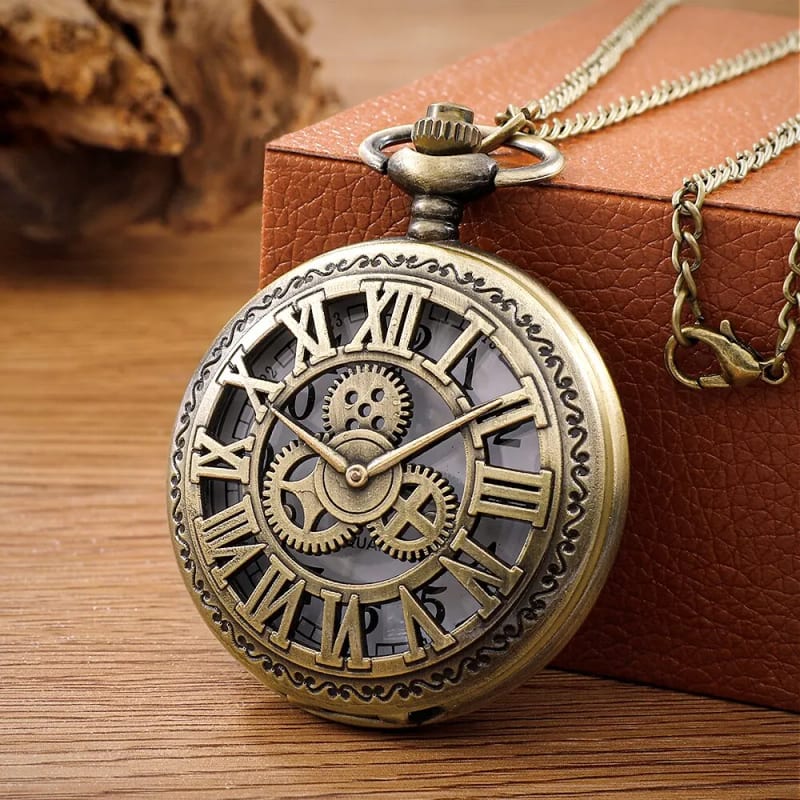
For anything that looks promising, take it to a watch repairer or an appraiser who specialises in watches, and compare with sold prices at auction rather than asking prices. If you simply want the look of a pocket watch for daily wear, a modern quartz one like our bronze steampunk pocket watch keeps time without winding and leaves the heirloom safe in the drawer. For the background, see pocket watch history.
Frequently asked questions
Are old pocket watches worth anything?
Some are worth a great deal, most are worth a modest amount. Solid gold cases, fine makers, high-grade movements and complications add the most value.
How do I know if my pocket watch is solid gold?
Look inside the case back for a karat or fineness mark such as 14K or 0.585. "Gold filled" or "rolled gold" means a thin gold layer over base metal.
How do I find the value of a pocket watch by serial number?
Use the serial number on the movement to find the maker's production year and grade, then compare similar watches in auction results.
Should I clean an old pocket watch before selling it?
No. Polishing and amateur cleaning can lower its value. Leave it as found and let a professional assess it.