Pocket Watch History: From Nuremberg to the Railroads
Nov 9, 2026 · The Editors
A short history of the pocket watch: the first portable clocks of the 1500s, the waistcoat and the balance spring, railroad watches and the Kipton crash, the move to the wrist, and pocket watch vs wrist watch today.
For about four hundred years, a watch meant a pocket watch. It was a mark of status, a family heirloom, and — on the railroads — a matter of life and death. Then, in roughly a generation, it moved to the wrist. Here is the story, with the dates that matter.
Pocket watch history timeline
| When | What happened |
|---|---|
| Early 1500s | Spring-driven portable clocks appear in Germany and Italy |
| Late 1500s | Small watches worn as pendants on a chain around the neck |
| 1675 | Christiaan Huygens's balance spring makes watches far more accurate |
| Late 1600s | The waistcoat becomes fashionable; the watch moves into its pocket |
| 1700s–1800s | Jewelled bearings, better escapements, minute hands become standard |
| 1850s onward | American factories mass-produce watches with interchangeable parts |
| 1891 | The Kipton train crash leads to strict railroad watch standards |
| 1914–1918 | Soldiers in the trenches adopt the wristwatch |
| 1930s | Wristwatches outsell pocket watches |
The first watches
The key invention was the mainspring: a coiled spring that stores energy, so a clock no longer needs heavy hanging weights. By the early 16th century, makers in southern Germany and northern Italy were building small spring-driven clocks that could be carried. Peter Henlein, a locksmith of Nuremberg, is often credited as the inventor of the watch, though historians debate how much of the story is legend.
These early pieces were often drum-shaped or round, worn on a chain around the neck or fixed to clothing. They had only an hour hand, and they could easily drift by a large margin in a day. They were jewellery as much as timekeepers.
Into the waistcoat pocket
Two changes in the late 17th century made the pocket watch what we picture today. In 1675, the Dutch scientist Christiaan Huygens developed the balance spring, which made watches dramatically more accurate — accurate enough to make a minute hand worthwhile. At about the same time, the waistcoat became fashionable in England after Charles II promoted it at court. A flat, round watch slipped neatly into its pocket, on a chain fixed to a buttonhole — the look still worn today. See how to wear a pocket watch.
Hunter and open face
Two case styles settled in the 19th century. The hunter has a hinged lid that protects the crystal, said to have been favoured by men who rode to hounds. The open face has no lid and can be read at a glance. More in hunter vs open face pocket watch.
Railroad watches
In April 1891, two trains collided at Kipton, Ohio. One explanation offered at the time was that an engineer's watch had stopped for a few minutes. In response, the railroads appointed a watch inspector, Webb C. Ball, who helped draw up strict standards: railroad watches had to keep time within a small margin per week, be inspected regularly, use an open face for easy reading, and be set by lever rather than by pulling the crown, so they could not be knocked off time by accident. "Railroad grade" became a byword for reliability.
The move to the wrist
Wristwatches existed in the 19th century but were seen mainly as jewellery for women. The First World War changed that. An officer timing an attack could not fumble with a pocket watch, so soldiers strapped them to their wrists, and they came home wearing them. By the 1930s, wristwatches were outselling pocket watches, and the pocket watch slowly became a formal or sentimental piece.
Pocket watch vs wrist watch today
| Pocket watch | Wrist watch | |
|---|---|---|
| Reading the time | take it out, open it | glance at your wrist |
| Wear and tear | protected in a pocket | knocks against desks and doors |
| Style | formal, distinctive, deliberate | everyday |
| Best for | weddings, waistcoats, keepsakes | daily use |
Most people who carry a pocket watch now do it because they enjoy the ritual — taking it out, opening the cover — and because it marks an occasion. It is also one of the few gifts that is still handed down.
Mechanical or quartz
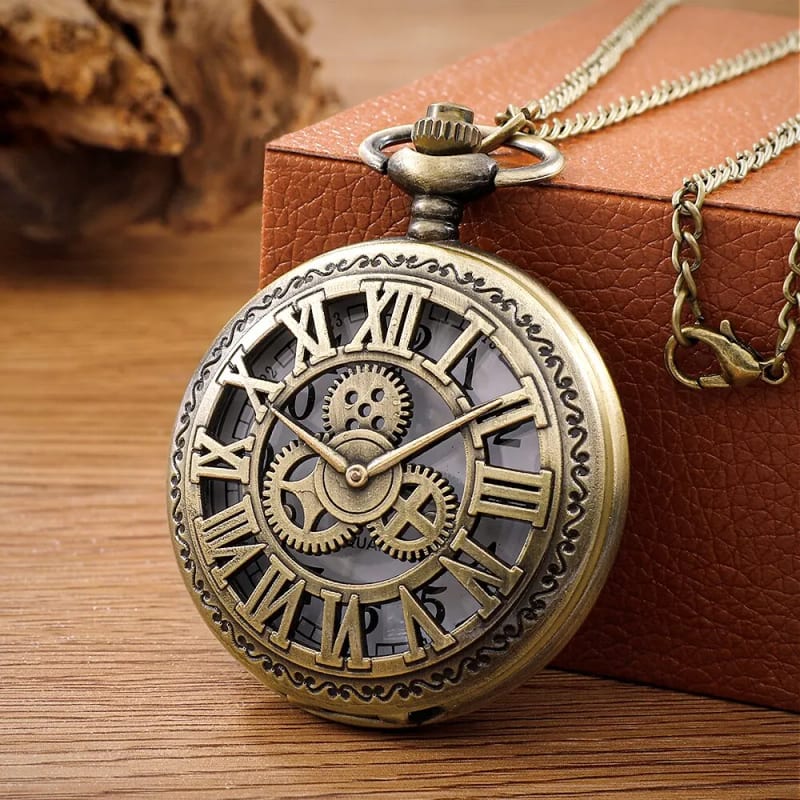
A traditional mechanical watch must be wound — see how to wind a pocket watch. Quartz movements, which arrived in the late 1960s, run on a battery and keep time without winding. Our steampunk pocket watch is quartz, with an open gear-work cover over a white Roman-numeral dial and a long chain: the old look, without the daily winding.
Mentioned above