How to Find North Without a Compass, by Day and by Night
Nov 23, 2026 · The Editors
How to find north without a compass: the shadow-stick method and the watch method by day, the North Star and the Southern Cross by night, and which old tricks don't work.
To find north without a compass during the day, use a shadow: put a stick upright, mark the tip of its shadow, wait 15 to 20 minutes and mark it again. The line from the first mark to the second runs roughly west to east, so north is at right angles to it. At night in the northern hemisphere, find the North Star, which sits almost exactly over true north.
By day: the shadow-stick method
This works anywhere the sun casts a clear shadow, in either hemisphere.
- Push a straight stick upright into flat ground.
- Mark the tip of its shadow with a stone.
- Wait 15 to 20 minutes, then mark the new tip.
- Draw a line from the first mark to the second. The first mark is west; the second is east.
- Stand with the first mark on your left and the second on your right. You are facing north.
It is approximate, and most accurate around the middle of the day, but good enough to choose a direction.
By day: the watch method
You need a watch with hands, set to the correct local time.
In the northern hemisphere: hold the watch flat and point the hour hand at the sun. The direction halfway between the hour hand and 12 is roughly south, so north is the opposite way. During daylight saving time, use 1 instead of 12.
In the southern hemisphere: point the 12 at the sun. Halfway between 12 and the hour hand is roughly north.
The method is rough, especially near the tropics and close to midday, but it is a handy check. A pocket watch with a clear dial works perfectly.
The sun in general
- The sun rises roughly in the east and sets roughly in the west. It is due east and west only around the equinoxes; in summer it rises and sets further north (in the northern hemisphere), in winter further south.
- At midday, outside the tropics, the sun is roughly due south in the northern hemisphere and due north in the southern hemisphere.
At night in the northern hemisphere: the North Star
- Find the Big Dipper (the Plough), seven bright stars in the shape of a ladle.
- Take the two stars at the end of the bowl, the "pointers".
- Follow the line they make, about five times the distance between them, to a moderately bright star on its own. That is Polaris, the North Star.
- Face it, and you are facing true north.
If the Dipper is below the horizon, the W-shaped constellation Cassiopeia, on the other side of Polaris, can guide you.
At night in the southern hemisphere: the Southern Cross
There is no bright south star. Instead:
- Find the Southern Cross, four bright stars in a kite shape, with two bright "pointer" stars beside it.
- Extend the long axis of the cross about four and a half times its length to reach an empty patch of sky, the south celestial pole.
- Drop straight down from that point to the horizon. That is south, so north is behind you.
Myths that don't work
- Moss grows on the north side of trees. Moss grows wherever it is damp and shady, which can be any side.
- Satellite dishes all point south. Only in some regions, and not reliably.
True north and magnetic north
The North Star shows true north, the direction of the North Pole. A compass shows magnetic north, which can differ by several degrees depending on where you are. See how a compass works, how to use a compass and does a compass work in the southern hemisphere.
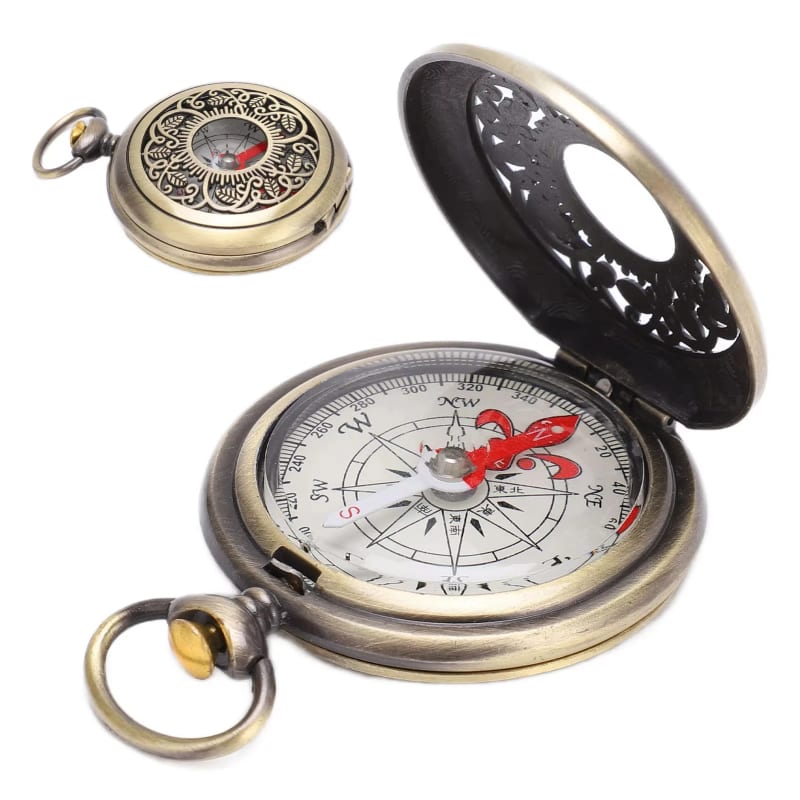
The easiest method of all, of course, is to carry one: a hinged pocket compass weighs almost nothing.
Frequently asked questions
How do you find north without a compass during the day?
Use the shadow-stick method: mark a shadow tip, wait 15 to 20 minutes, and mark it again. The first mark is west and the second east, so north is at right angles to the line.
How do you find north at night?
In the northern hemisphere, follow the two pointer stars of the Big Dipper to the North Star, which marks true north. In the southern hemisphere, use the Southern Cross to find south.
How do you find north with a watch?
In the northern hemisphere, point the hour hand at the sun; halfway between it and 12 is south, so north is opposite. In the southern hemisphere, point 12 at the sun; halfway to the hour hand is north.
Does moss grow on the north side of trees?
Not reliably. Moss grows wherever it is damp and shaded, so it is not a safe way to find direction.
Mentioned above