Double Pendulum: Why It's Chaotic (Chaos Theory Explained)
Nov 12, 2026 · The Editors
What a double pendulum is, why its motion is chaotic even though it follows simple laws, what sensitive dependence on starting conditions means, the equations in plain words, and the double pendulum as a desk toy.

A double pendulum is a pendulum with a second pendulum hanging from its end. It obeys simple, exact laws of physics, yet released from a high starting point its motion is chaotic: it never repeats, and two releases that differ by a hair soon look completely different. It is one of the simplest machines that shows what chaos theory means.
What is a double pendulum?
Take a rod that swings from a pivot. At its lower end, add a second pivot and a second rod. Each arm can swing, and each one pushes and pulls on the other. To describe where it is, you need two numbers — the angle of each arm — rather than the one a single pendulum needs.
A single pendulum swings back and forth with a regular beat; that regularity is why it was used to keep time in clocks. The double pendulum gives up that regularity.
Why is the double pendulum chaotic?
Chaos, in the mathematical sense, does not mean random. It means deterministic but unpredictable:
- Deterministic — the same exact start always gives the same exact motion. Nothing in the system is random.
- Sensitive to starting conditions — two starts that differ by a tiny amount drift apart faster and faster, until their motions have nothing in common.
Since no real release is ever exactly the same, and no measurement is perfect, the motion cannot be predicted far ahead in practice. This is the same "butterfly effect" that limits long-range weather forecasts.
Small swings vs big swings
The chaos depends on energy:
| Starting swing | Behaviour |
|---|---|
| Small (arms barely lifted) | Nearly regular; a mix of two steady rhythms |
| Medium | Irregular, but the arms rarely flip over |
| Large (arms raised high) | Fully chaotic; the lower arm whirls and flips unpredictably |
The equations of motion, in plain words
Physicists write the motion using the Lagrangian method, which works from the energy of the system: the kinetic energy of the two moving masses minus their potential energy from height. That gives two linked equations, one for each angle, where each arm's acceleration depends on the other's position and speed.
There is no neat formula that gives the position at any future time. Instead, the equations are solved step by step on a computer — which is how double pendulum simulations work. Because of the sensitivity, even a simulation drifts away from a real pendulum after a short while.
The double pendulum fractal
If you run a simulation for many starting angles and colour each one by how long it takes the lower arm to flip, you get a picture with intricate, fractal-like borders between calm and wild regions. The edges are where tiny changes in the start make the biggest difference.
The double pendulum as a desk toy
Large double pendulums are used in science museums and classrooms. On a desk, the idea comes as a handheld spinner: our chaos pendulum fidget spinner has two linked arms on bearings, the second swinging off the first. Spin it and it settles into no pattern at all — predictable for a moment, then never repeating.
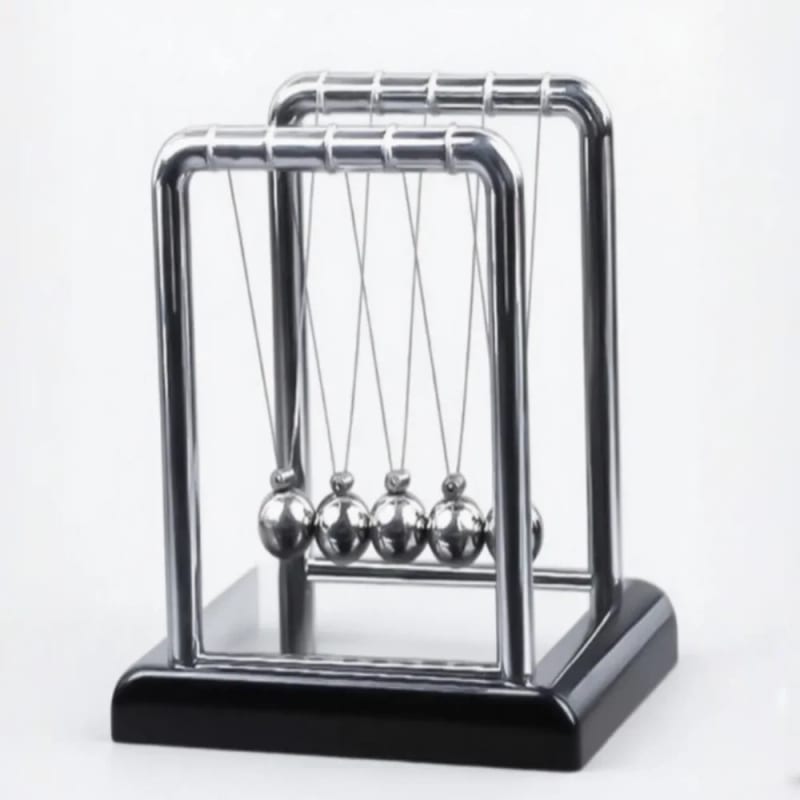
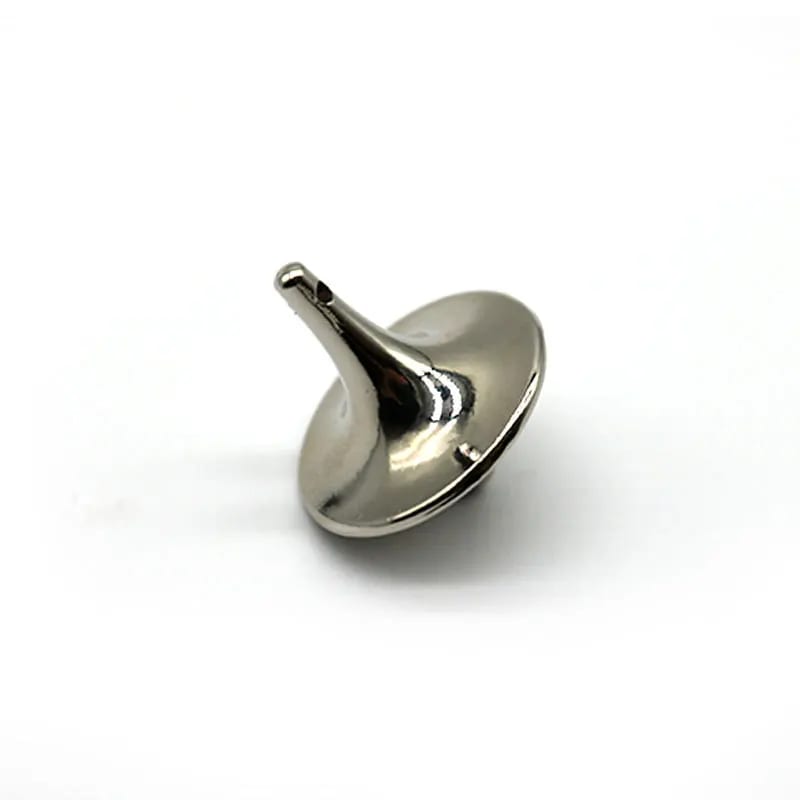
It sits well beside the other classic physics toys: a Newton's cradle, which shows momentum and energy passing through a line of balls (see how a Newton's cradle works), and a precision spinning top, which shows angular momentum (see how a spinning top works). For more, see executive desk toys.
Frequently asked questions
Why is a double pendulum chaotic?
Its two arms push and pull on each other, so tiny differences in the starting position grow rapidly. The motion is fully determined by physics but cannot be predicted far ahead.
Is a double pendulum random?
No. The same exact start always gives the same motion. It is chaotic, meaning extremely sensitive to starting conditions, not random.
Does a double pendulum ever repeat?
When released from a high position, practically never. With very small swings it moves in a nearly regular pattern.
What is the double pendulum used for?
It is a classic demonstration of chaos theory in physics teaching and museums, and a popular desk toy.
Mentioned above