The Linking Rings
18th century
One of the most famous effects in magic: solid metal rings that link together, chain and come apart again in the performer's hands. Usually called the Chinese linking rings, its origins are uncertain; the earliest known written record is usually dated to a Japanese book of 1764.
From the shop
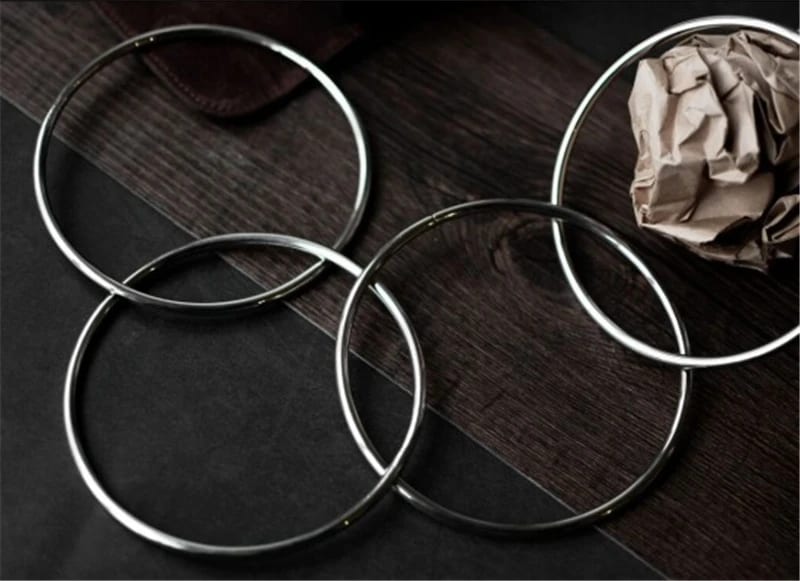
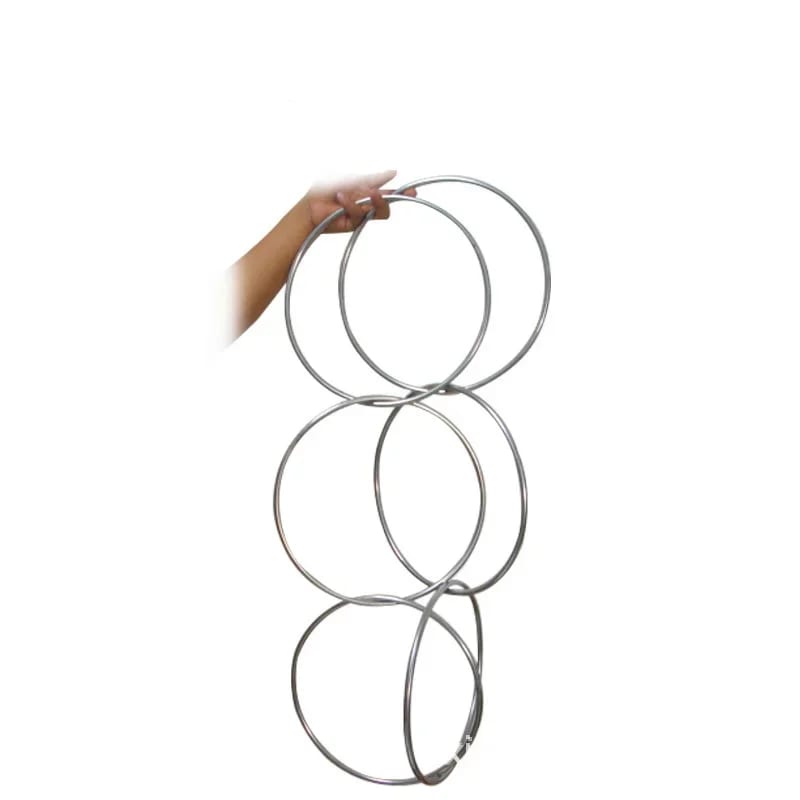
The linking rings is one of the oldest and best-loved effects in magic. Large metal rings, often handed to spectators to examine, pass through one another, link into chains and shapes, and then separate again. It is usually known as the Chinese linking rings, although where it really began is still argued over by historians.
Who first presented it
Nobody knows who first performed the linking rings. For a long time it was said to be an ancient Chinese trick, and in the nineteenth century European audiences did associate it with travelling Chinese conjurors. Modern historians are more cautious. The magic historian Max Maven identified a Japanese book of 1764 as the earliest known written record of the trick, and some writers now argue that the effect may be neither as ancient nor as Chinese as its name suggests.
In Europe, the French conjuror known as Philippe is often credited with bringing the rings to the stage in the first half of the nineteenth century, presenting them as part of a Chinese-themed act. Around 1900 the great Chinese magician Ching Ling Foo made the rings a highlight of his international tours, and from then on they were part of the repertoire of almost every stage magician.
What the audience sees
The magician shows a set of large rings, usually between six and twelve of them, and lets them clash and ring against one another. Then, often slowly and in full view, one ring passes into another and the two hang linked together. More rings join until the performer holds a chain, then shapes such as a globe or a flower, and at the end the rings fall apart again into separate circles. It is one of the purest examples of a penetration, solid through solid.
Famous performances
Ching Ling Foo's version helped make the rings famous in America and Europe. In the twentieth century many leading magicians built their own routines: Dai Vernon's version, published as The Symphony of the Rings, is admired for its slow, quiet pace. The Dutch magician Richard Ross won the Grand Prix at the FISM world championships of magic in 1970 and 1973 with an act whose centrepiece was a slow-motion linking rings routine.
Why it endures
The rings need no story to be understood. Everyone knows that solid metal cannot pass through solid metal, and the effect can be shown on a large stage, in a small room or in the street. That simplicity has kept the trick in constant use for at least two and a half centuries. Its method is a magician's secret; its history is told in more detail on our linking rings effect page.
Frequently asked questions
Who invented the linking rings?
Nobody knows. The earliest known written record is usually dated to a Japanese book of 1764, and the trick's link with China is now questioned by historians.
Why are they called the Chinese linking rings?
Because nineteenth-century European audiences associated the trick with Chinese conjurors, and performers such as Philippe and Ching Ling Foo presented it in a Chinese style.
How many rings are in a linking rings set?
Sets vary. Stage routines often use eight, but versions with four, six, seven or twelve rings are common.
Coming soon
Want to learn magic properly?
We're preparing lessons that teach classic tricks step by step, for members. Leave your email and we'll write once, when they open. Nothing else.
See also
From the shop