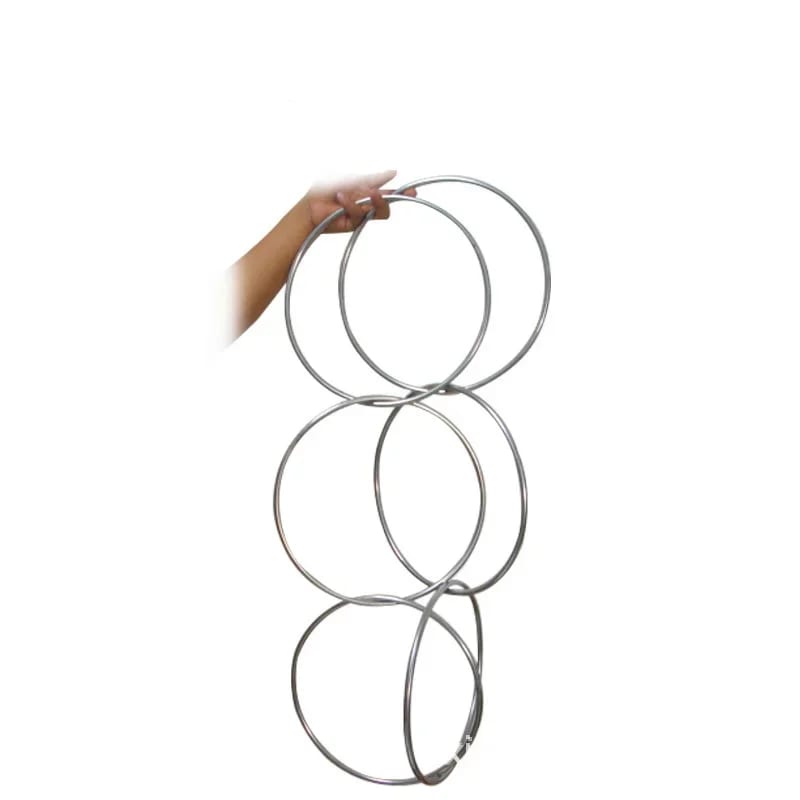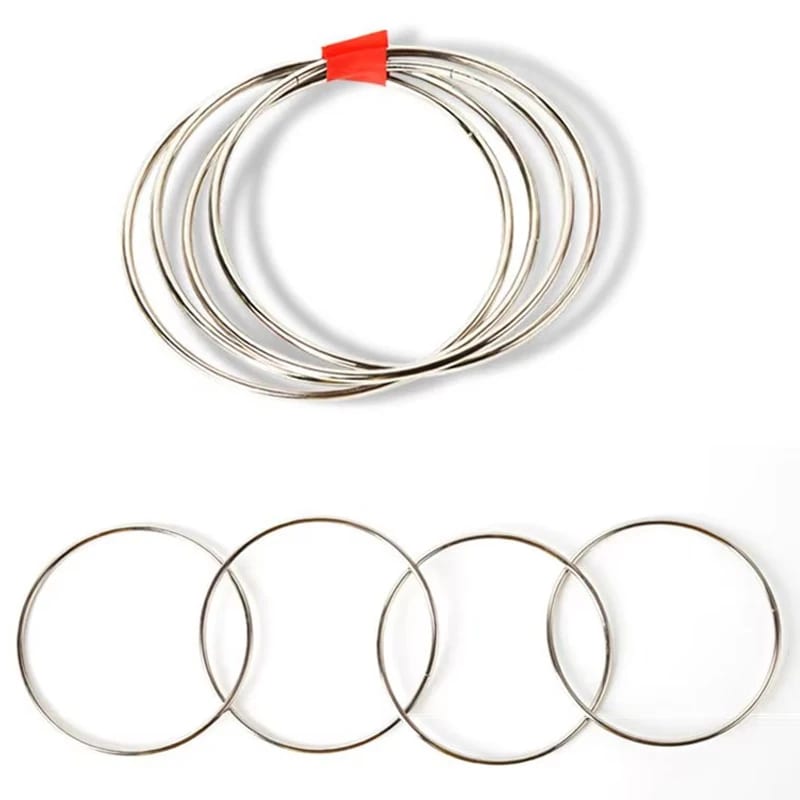
Linking Rings — Set of Four
$20.99Beginner
Solid metal rings knock together, pass through one another, and hang linked in a chain — then come apart and are handed out.
What they see
The rings are counted, one at a time, and tapped against each other so the room hears that they are solid. Two are held up and knocked together: metal on metal, no join.
Then one passes through the other and they hang linked. More join the chain. The rings are spun, swung, and built into shapes — a chain, a flower, a long hanging line — and at any moment a ring can be lifted clear and passed to someone in the front row.
The finish is usually the handing out. The rings go round the audience, come back, and link again.
Provenance
Nearly every account calls the rings Chinese and ancient, and nearly every account is repeating a nineteenth-century dealer's claim rather than a source. The earliest firm European records are from the early 1800s, and the routine became a staple of Victorian stage magic from there.
What is well documented is the modern shape of it. Ching Ling Foo and Chung Ling Soo — one Chinese, one a Englishman named William Robinson in costume — both built the rings into major stage acts around 1900. Dai Vernon's Symphony of the Rings, published in the 1960s, is the routine most performers still learn from, and it reduced a cumbersome eight-ring set to something with a shape and an ending.
Penn and Teller's version, performed with the method announced in advance, is the strongest argument that the effect survives knowing how it is done.
Learning it
The individual moves are simple. The routine is not, and the gap between the two is where most people stop.
Rings are heavy, loud, and visible from the back of a room, which means every angle matters and there is nowhere to hide a fumble. A three-ring routine can be performed competently within a month. An eight-ring routine takes a year, mostly spent on what the rings are doing when they are not linking.
Start with three or four. The large stage sets look impressive in the box and are considerably harder to handle than they appear — the weight is real, and so is the noise when you drop one.
What you need
Next
Appearance
A bouquet that was not there a second ago — spring flowers that fill a hand, or a bare stick that blooms along its length.
Appearance
Squares of fine silk produced from nowhere, vanished, knotted, coloured and changed — the material that makes stage production possible.
Appearance
A walking cane arrives in an empty hand with a crack like a whip — the fastest production in magic and the standard opener for a century.