Vegvisir Meaning: The Icelandic 'Wayfinder' Symbol (and Is It Viking?)
Nov 16, 2026 · The Editors
The vegvisir is an Icelandic magical stave whose name means 'wayfinder', meant to keep its bearer from losing the way in storms. Where it comes from, why it is not Viking-age, and what it means in a tattoo.
The vegvisir (Icelandic vegvísir, "way-shower" or "wayfinder") is an Icelandic magical stave meant to keep the person who carries it from losing their way in storms or bad weather, even when the way is unknown. It is often called the "Viking compass", but it comes from a nineteenth-century Icelandic manuscript, not from the Viking Age.
Where the vegvisir comes from
The vegvisir is recorded in the Huld Manuscript, a collection of Icelandic magic compiled in the mid-1800s. Its short instruction says, in effect, that whoever carries the sign will not lose their way in storms or bad weather, even when the way is not known.
It belongs to a family of Icelandic galdrastafir ("magical staves"): designs drawn for protection, luck, success in a quarrel or safety on a journey. Most surviving examples were written down centuries after Iceland became Christian.
What the vegvisir looks like
Eight arms radiate from a centre, each ending in a different branched or crossed mark. It resembles a compass rose, which is part of its modern appeal, but the arms are not the points of the compass and the end-marks are not letters. Compare it with the real mariner's symbol in our compass rose meaning.
Vegvisir meaning in Norse mythology: is it Viking?
No source from the Viking Age (roughly 793 to 1066) shows the vegvisir. It does not appear in the sagas, the Eddas or on rune stones. It is Icelandic folk magic, written down about eight centuries later. It is also not made of runes, though the staves draw on a similar visual tradition. If you want genuine Viking-age writing, the runes are the real thing: see Elder Futhark runes and their meanings.
That does not make the symbol less meaningful. It is a genuine piece of Icelandic tradition, and its message has not changed: find your way home.
Vegvisir meaning: spiritual and tattoo
Today the vegvisir is one of the most popular Norse-style tattoos and pendants. People choose it to mean:
- Guidance, especially through a hard period.
- Safe travel, for sailors, pilots and anyone who moves a lot.
- A way home, after a loss, an illness or a long time away.
A vegvisir tattoo is often placed on the forearm, chest or between the shoulders. Since it is a protective sign, some people pair it with a single meaningful rune.
Vegvisir and the compass
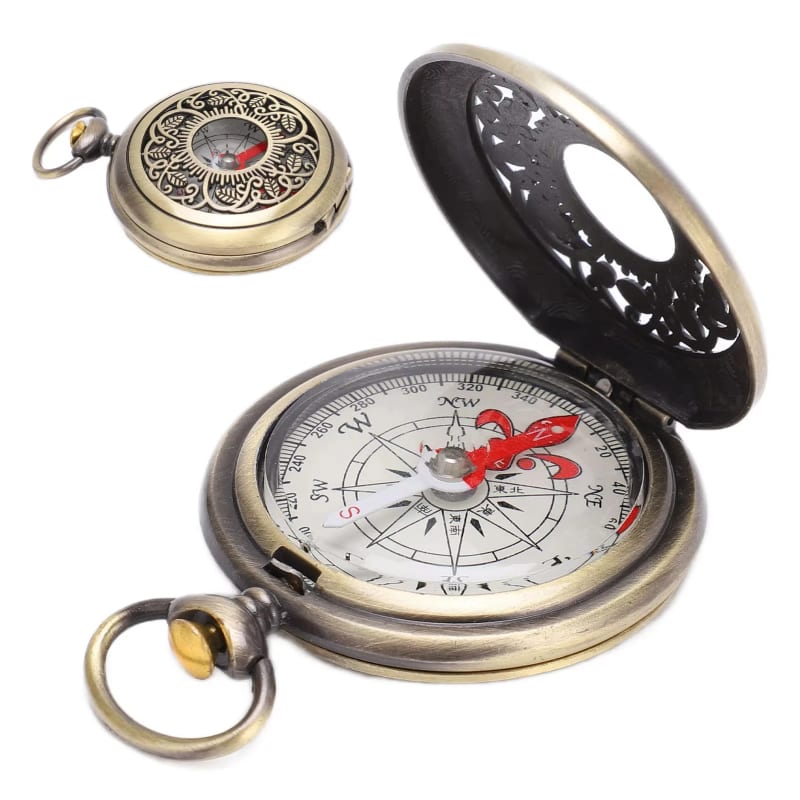
The vegvisir's message is the same one people give a compass for: wherever you go, may you find your way. A hinged pocket compass in antique bronze carries that meaning in an object that actually points north. Our guide to what a compass means as a gift has ideas for an engraving or note. For the Norse side, an Elder Futhark rune set has the oldest runic alphabet.
| Vegvisir | Elder Futhark runes | |
|---|---|---|
| Origin | Iceland, recorded mid-1800s | Northern Europe, from about the 2nd century |
| What it is | a magical stave | an alphabet |
| Used in the Viking Age? | no evidence | yes, in its later Younger Futhark form |
Frequently asked questions
What does vegvisir mean in English?
It means "way-shower" or "wayfinder", from the Icelandic vegur (way) and vísir (pointer, guide).
Is the vegvisir a Viking symbol?
No. It is recorded in a nineteenth-century Icelandic manuscript, and no Viking-age object or text shows it. It is often marketed as Viking, but it is Icelandic folk magic.
Is the vegvisir a Nazi symbol?
No. The vegvisir has no history in Nazi symbolism. The question comes up because some other Norse symbols have been misused by hate groups, which is why it is worth checking any symbol before choosing it.
Is the vegvisir made of runes?
No. Its arms end in magical staves, not runic letters, though Icelandic staves and runes share a similar look.