Quartz vs Mechanical Pocket Watch: Which Is Better?
Nov 23, 2026 · The Editors
Quartz vs mechanical pocket watch: how each one works, accuracy, winding, servicing, cost of ownership and which one suits a first pocket watch or a gift.

A quartz pocket watch runs on a battery and a vibrating quartz crystal; it is more accurate, needs no winding and costs little to keep. A mechanical pocket watch runs on a wound spring and a ticking balance wheel; it is less accurate but has the craftsmanship, sound and history that draw people to pocket watches. Which is better depends on whether you want a reliable timepiece or a small machine.
How each one works
Mechanical. A coiled mainspring stores energy when you wind the crown. It drives a train of gears, and a balance wheel swinging back and forth lets the energy out in small, even steps. That is the tick. Nearly every antique pocket watch is mechanical. See parts of a pocket watch.
Quartz. A battery sends current through a tiny piece of quartz crystal cut to vibrate at 32,768 times a second. A circuit counts the vibrations and moves a small motor once a second. Quartz watches arrived in the late 1960s and soon took over the mass market.
Quartz vs mechanical: side by side
| Quartz | Mechanical | |
|---|---|---|
| Power | battery | wound mainspring |
| Typical accuracy | a few seconds a week | several seconds or more a day |
| Daily care | none | wind it, usually once a day |
| Upkeep | a new battery every year or few | a service every few years |
| Second hand | jumps once a second | sweeps in small steps |
| Sound | faint tick, or none | a lively tick |
| Appeal | practical | craftsmanship and history |
Accuracy varies a lot from watch to watch, but in general a basic quartz watch keeps better time than a fine mechanical one.
Which is better: mechanical or quartz?
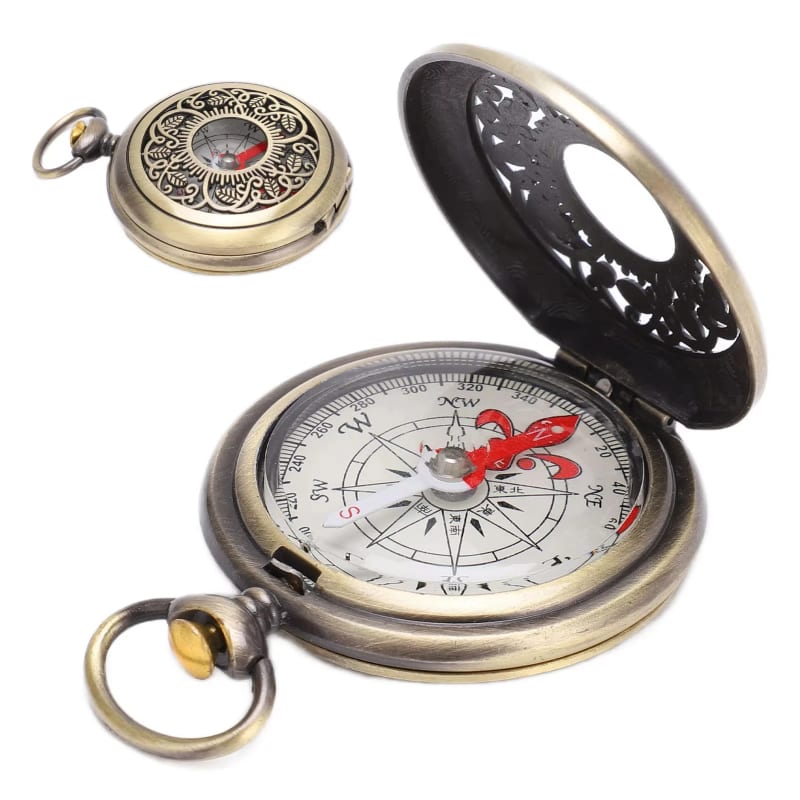
Choose quartz if you want a pocket watch to wear or carry, set once and forget. It suits a wedding, a costume, a groomsman's gift or someone who will not remember to wind it. Our steampunk pocket watch is quartz for exactly this reason: the gear-work cover gives it the look of a mechanical watch, and the movement keeps time without winding.
Choose mechanical if the point is the mechanism: the daily ritual of winding, the visible balance through an exhibition back, or the history of an antique. A mechanical watch is also the one to hand down, because a watchmaker can repair it with parts rather than replacing a module.
What is a quartz pocket watch, exactly?
It is a pocket watch case and dial with a modern quartz movement inside. From the outside it can look just like a Victorian watch, with a hunter cover, Roman numerals and a chain. You can usually tell by the second hand, which jumps once a second, and by a smooth case back with no winding needed. If you are unsure, see how to open a pocket watch.
Looking after each type
- Quartz: change the battery when the second hand starts jumping in two-second steps or stops; do not leave a dead battery inside, as it can leak. See pocket watch battery.
- Mechanical: wind it at the same time each day until you feel resistance, and have it serviced every few years. See how to wind a pocket watch.
- Both: keep them dry, out of strong magnetic fields, and in a pocket on their own, away from keys. How to clean a pocket watch covers the case and crystal.
Frequently asked questions
Which is more accurate, a quartz or a mechanical watch?
Quartz, by a wide margin. A basic quartz watch is usually off by a few seconds a week, while a mechanical watch can drift by several seconds a day or more.
Do quartz pocket watches need winding?
No. The battery powers them, so the crown is only used to set the time.
Is a mechanical pocket watch worth it?
If you enjoy the mechanism, the winding ritual and the history, yes. If you just want reliable time with the look of a pocket watch, quartz is the practical choice.
How can you tell if a pocket watch is quartz?
The second hand usually jumps once a second, the watch never needs winding, and the dial or case back may say quartz.
Mentioned above