Pocket Watch vs Wrist Watch: Pros, Cons and Why Pocket Watches Faded
Nov 23, 2026 · The Editors
Pocket watch vs wrist watch: which is more practical, which is more formal, why men switched to the wristwatch in the early twentieth century, and the difference between a pocket watch and a fob watch.
A wrist watch is more practical: you can read it at a glance with one hand. A pocket watch is more formal and more personal: it has to be taken out and opened, which makes checking the time a small ceremony, and it suits a waistcoat, a suit or a wedding. Pocket watches were the normal men's watch until the early twentieth century, when the wrist watch took over.
Pocket watch vs wrist watch at a glance
| Pocket watch | Wrist watch | |
|---|---|---|
| reading the time | take it out, sometimes open a lid | glance at the wrist |
| hands needed | usually two | none, or one |
| best with | waistcoat, suit, formal wear | anything |
| risk | dropping it | knocks and scratches on the wrist |
| feel | ceremony, heirloom | everyday tool |
| comfort | nothing on the wrist | strap all day |
Why pocket watches went out of fashion
For most of the nineteenth century a man's watch lived in his pocket, often on a chain across the waistcoat. Wrist watches existed, but were mostly worn by women, as bracelet watches.
The change came in the early twentieth century. Pilots, cyclists and especially soldiers in the First World War needed to check the time without reaching into a pocket, and watches strapped to the wrist proved their worth. Men who came home kept wearing them, and by the 1930s the wrist watch had become the normal men's watch. The three-piece suit, and the waistcoat pocket with it, faded at the same time.
Pocket watches did hold on where accuracy and clarity mattered most. American railroads kept strict pocket-watch standards for decades after an 1891 collision in Ohio blamed partly on a watch that had stopped. Our pocket watch history tells the longer story.
Why people still choose a pocket watch
- Formal wear. With a waistcoat at a wedding, a pocket watch on a chain finishes the outfit in a way a wrist watch cannot. See how to wear a pocket watch.
- Nothing on the wrist. Some people dislike a strap, or wear a fitness band there instead.
- Ceremony. Opening a watch to check the time slows the moment down, which many owners say is the point.
- Gift and heirloom. A pocket watch is the classic gift for a groom, a best man or a retirement, and it is the kind of object passed down. See what a pocket watch means as a gift.
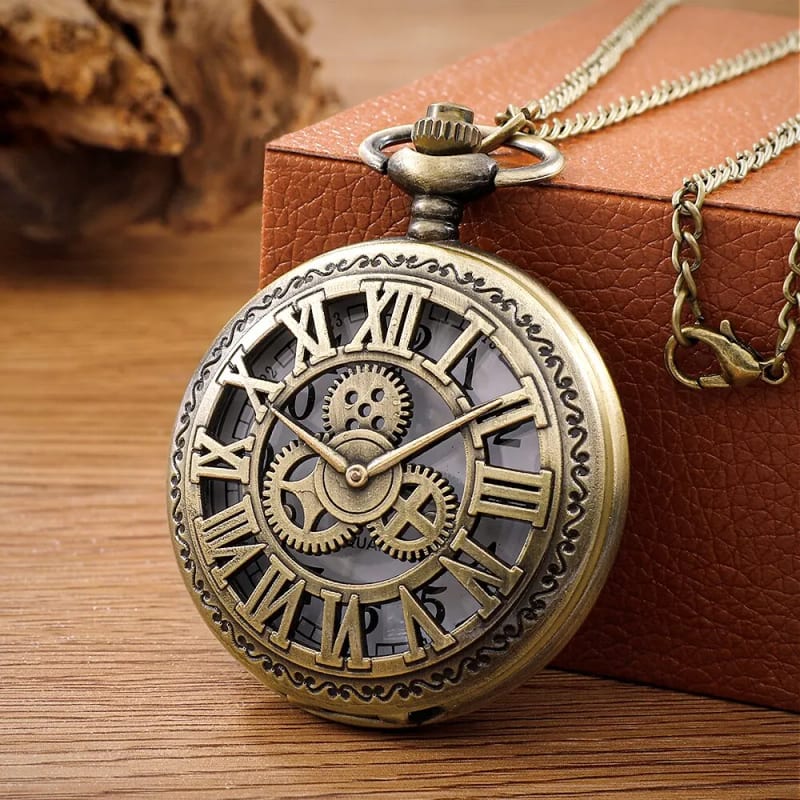
A steampunk pocket watch with a cut-away cover is an easy first one: it runs on quartz, so it keeps time without daily winding.
Pocket watch vs fob watch
The words overlap. A fob was originally a small pocket in the waistband of a man's trousers, and later the short chain or ribbon hanging from a watch in it. Today fob watch usually means one of two things:
- a pocket watch worn on a short strap or chain from a trouser pocket or belt, or
- a nurse's watch, pinned to a uniform and hung upside down, so it reads the right way up when lifted.
Which should you buy?
If it will be worn every day at work, buy a wrist watch. If it is for occasions, for a waistcoat, or as a gift with meaning, a pocket watch carries far more weight. Many people own both.
Frequently asked questions
Is a pocket watch better than a wrist watch?
Not more practical, but more formal and more personal. A wrist watch is easier to read; a pocket watch suits formal wear and makes a gift with meaning.
Why did people stop using pocket watches?
Wrist watches proved more practical in the First World War and spread among men afterwards. By the 1930s they had become the usual men's watch, and the waistcoat pocket was disappearing too.
Are pocket watches still worn?
Yes, mainly with formal wear, at weddings and by people who prefer nothing on the wrist. They remain a popular gift for grooms and groomsmen.
What is the difference between a pocket watch and a fob watch?
A fob watch is usually a pocket watch worn on a short strap from a trouser pocket or belt, or a nurse's watch pinned upside down to a uniform.