Is a Coin Flip Really 50/50? What the Research Says
Nov 7, 2026 · The Editors
Is a coin flip 50/50 or 51/49? What the research by Persi Diaconis and a 350,000-flip study found, why coins favour the side they start on, spinning versus flipping, and how often a coin lands on its edge.
Almost, but not quite. A coin flipped by a person lands on the same side it started on a little more often than not — about 51% of the time. Over a few flips nobody would notice. Over thousands, the bias is real.
The theory: Diaconis, 2007
In 2007, the Stanford mathematician and former magician Persi Diaconis, with Susan Holmes and Richard Montgomery, published an analysis of the physics of a coin toss.
Their finding: a flipped coin does not just spin end over end. It also wobbles — it precesses, like a spinning top. Because of that wobble, the coin spends slightly more time in the air with its starting face pointing up. They calculated that a coin caught in the hand would show the starting side about 51% of the time.
They also built a coin-flipping machine that could make a coin land the same side up every single time — proof that a coin toss is physics, not chance. What makes it random is the small variation in each human flip.
The test: 350,757 flips, 2023
In 2023, a team led by František Bartoš at the University of Amsterdam set out to test the prediction. Forty-eight people flipped coins from 46 currencies a total of 350,757 times.
The result: coins landed on the side they started on 50.8% of the time — just as predicted. Some flippers showed a much stronger bias than others. The bias was the same for heads and tails, so the coins themselves were fair; the bias came from the flip.
So is it 50/50 or 51/49?
- If nobody knows which side started up: it is effectively 50/50.
- If you know the starting side: call that side, and you win about 51% of the time.
That is why a fair toss is one where the flipper doesn't look at the coin before tossing it.
Spinning a coin is much less fair
Spinning a coin on its edge on a table is a different matter. As it slows, it falls towards its heavier side. Coins with a raised design on one face can show a strong bias when spun — far more than 51%. Never settle an argument by spinning.
Can a coin land on its edge?
Yes — rarely. A 1993 study estimated a US nickel would land on its edge about once in 6,000 tosses onto a hard surface. Thicker coins land on their edges more often.
Is a coin flip a good way to decide?
For anything where both options are fine, yes — and there is a useful side effect. A coin flip often tells you what you wanted: if you feel disappointed by the result, you know which way you really leaned.
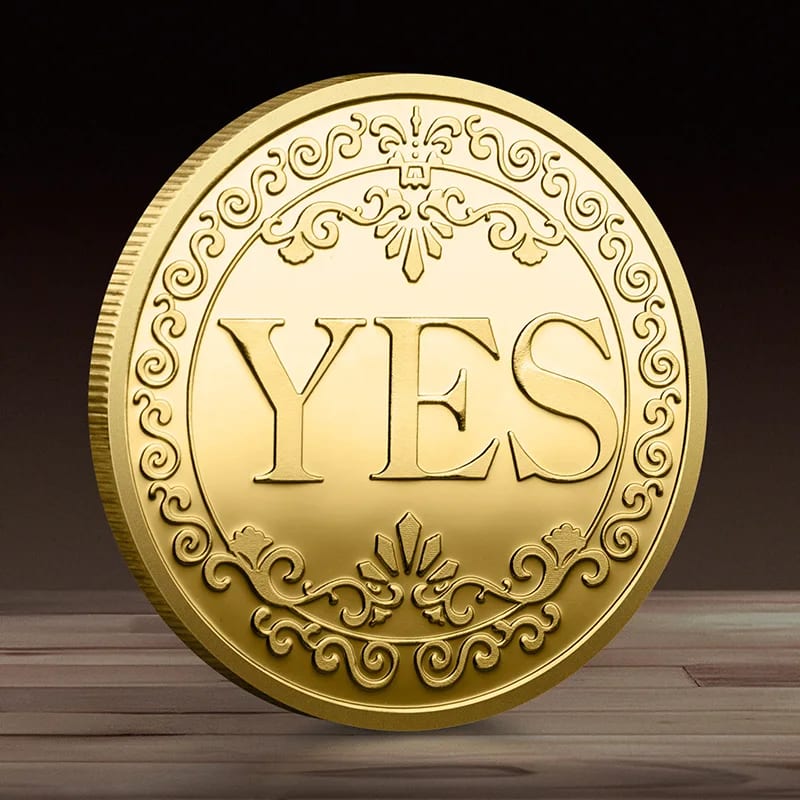
A yes/no decision coin makes the most of it: one face says YES, the other NO, and nobody has to remember what heads meant. How to flip a coin properly.