The Flying Dutchman Legend: Origin, Story and Sightings
Nov 9, 2026 · The Editors
The legend of the Flying Dutchman: the ghost ship doomed never to make port, where the story came from, the captain's names, Wagner's opera, famous sightings and the mirage that may explain them.
The Flying Dutchman is the most famous ghost ship of the sea: a vessel doomed to sail forever and never make port, seen in storms off the Cape of Good Hope, glowing with a strange light. To sailors, seeing her was the worst of omens. The story is more than two centuries old and still turns up everywhere from opera to films.
The story of the Flying Dutchman
The legend's core is always the same. A Dutch captain, rounding the Cape of Good Hope in a fierce storm, refuses to turn back. In many versions he swears he will round the cape if it takes until Judgement Day — and he is taken at his word. He and his ship are condemned to beat against the wind forever.
Other common details:
- The ship tries to hail passing vessels and hand over letters for home, addressed to people long dead. Accepting them brings disaster.
- She appears in bad weather, under full sail when no ship could carry sail.
- Seeing her foretells shipwreck or death.
Strictly, "the Flying Dutchman" is the name of the ship, though people often use it for the captain too.
Where the legend came from
The story grew out of the great age of Dutch sea trade in the seventeenth and eighteenth centuries, when Dutch East India Company ships made the long, dangerous passage round the Cape to Asia. The earliest known printed accounts date from the 1790s, describing sailors' belief in a ghost ship off the Cape.
The captain's name varies. Hendrick van der Decken ("Vanderdecken") appears in an influential 1821 magazine story. Some versions name Bernard Fokke, a real Dutch captain remembered for voyages so fast that people whispered he had help from the devil. Neither is proven to be "the" Dutchman; the legend gathered names as it travelled.
Wagner's opera: The Flying Dutchman
Richard Wagner's opera Der fliegende Holländer (The Flying Dutchman), first performed in Dresden in 1843, gave the legend its most famous form. Drawing on a version by the poet Heinrich Heine, Wagner's Dutchman may come ashore once every seven years, and he can be released from his curse only by a woman who will be faithful to him until death. The opera added redemption to a story that had been pure doom, and its storm-tossed overture is still one of the best-known pieces of sea music.
Famous sightings
The best-known reported sighting came in 1881, when the future King George V was serving as a young midshipman aboard HMS Bacchante. The published account of the voyage records that a strange ship glowing red was seen in the early morning off the coast of Australia by several of the crew, and that a sailor who first reported her later fell from the rigging and died.
Sailors' sightings continued into the twentieth century, usually in the same waters off southern Africa.
The mirage that may explain it
The likeliest explanation is a superior mirage, sometimes called a Fata Morgana. When warm air lies over cold sea, light bends so that ships beyond the horizon appear floating above it, stretched or upside down. A distant ship lifted into the sky and glowing in low sun would look exactly like a phantom.
The Flying Dutchman as a symbol
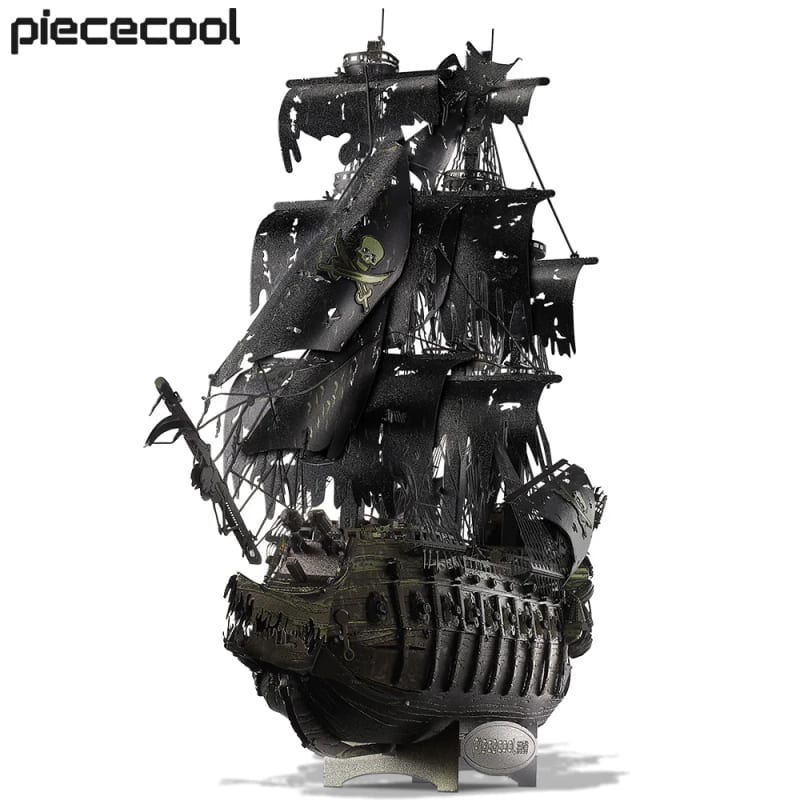
Today the Dutchman stands for anyone condemned to wander without rest — a symbol of stubbornness, exile and longing for home. It is a natural subject for a model: our 3D metal model kit of the Flying Dutchman builds the ghost ship from folded metal, with ragged sails. If you are building one, our guide to metal model kits for adults explains the tools and the method. For more sea legends and their symbols, see pirate flag meanings and the compass rose.