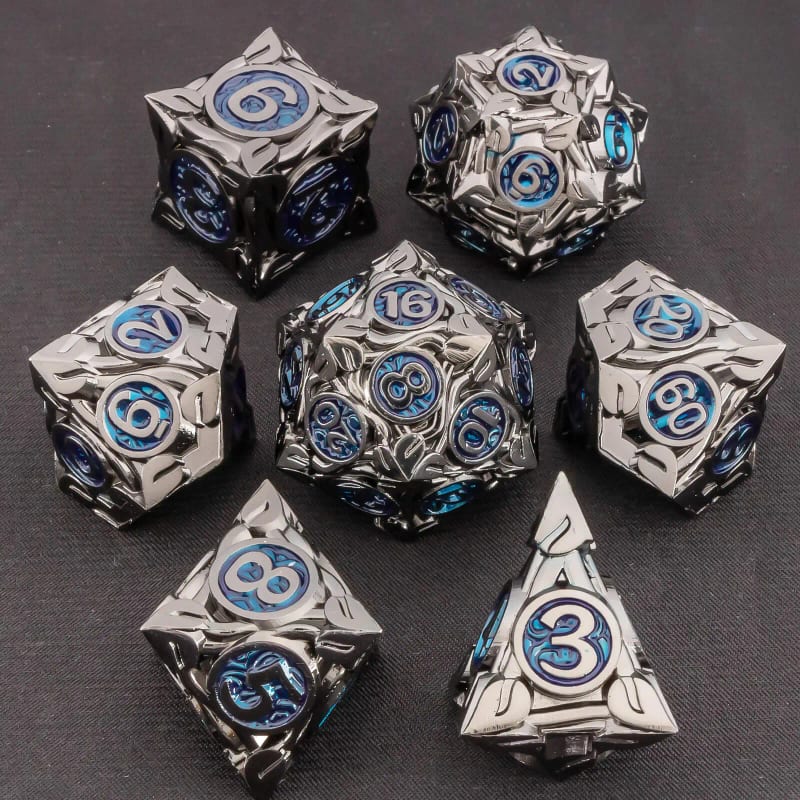
D&D Dice Names and What Each Die Is For
Nov 7, 2026 · The Editors
The names of the seven dungeons and dragons dice — d4, d6, d8, d10, percentile, d12 and d20 — their shapes and geometry, what each is rolled for, and how to read the tricky ones.
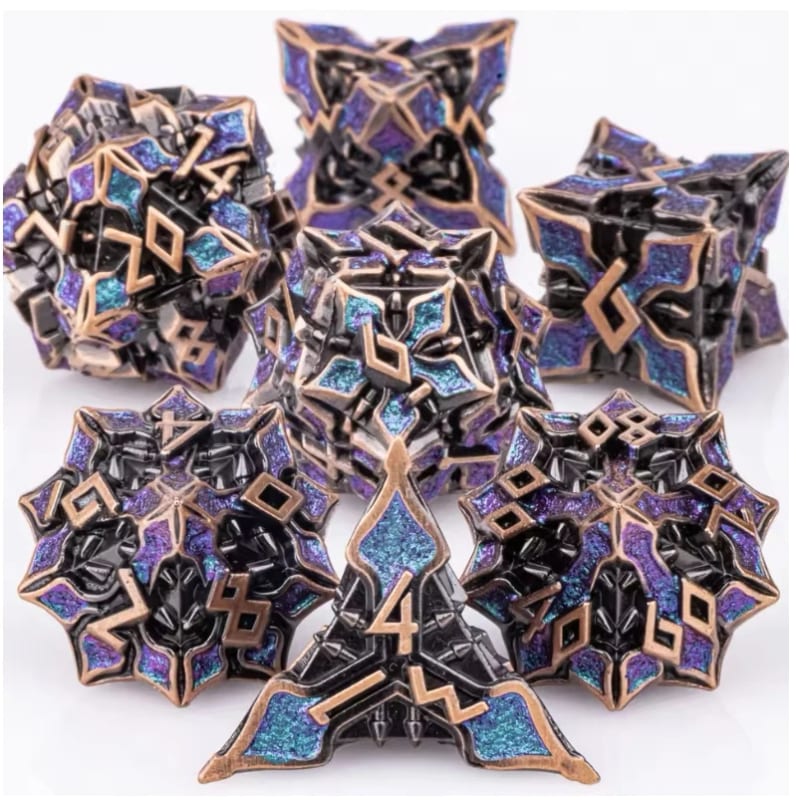
A standard roleplaying dice set has seven dice. Each is named by its number of sides: "d" for die, plus the number. Here is each one, its shape, and what it is for in Dungeons & Dragons and games like it.
The seven dice
| Name | Shape | Used for (typical) |
|---|---|---|
| d4 | Tetrahedron — a pyramid | Small weapons, healing potions, minor spells |
| d6 | Cube | Many weapons and spells — a fireball is 8d6 |
| d8 | Octahedron | Longswords, healing spells |
| d10 | Pentagonal trapezohedron | Heavy weapons, some damage spells |
| d% / d00 | The same shape, marked 00–90 | With the d10, rolls 1–100 |
| d12 | Dodecahedron | Greataxes, the toughest hit dice |
| d20 | Icosahedron | Every attack, check and saving throw |
d4 — the pyramid
Four triangular faces. It has no top face, so the number is read differently: look for the number that is upright at the top point, or along the bottom edges, depending on the design. Every d4 shows the result the same way on all three visible faces. Notoriously painful to step on.
Used for: daggers, healing potions (2d4 + 2), magic missiles.
d6 — the cube
The ordinary die. Rolled in handfuls for big spells and sneak attacks.
Used for: shortswords, fireballs, sneak attacks, rolling up character stats (4d6, drop the lowest).
d8 — the octahedron
Eight triangular faces, like two pyramids base to base.
Used for: longswords, rapiers, many healing spells and the hit dice of many classes.
d10 and the percentile die
Ten kite-shaped faces. A set includes two of them: one numbered 0–9 (where 0 means 10) and one numbered 00–90 in tens — the percentile die.
To roll d100, roll both together and add them: 40 and 7 is 47. 00 and 0 is 100. 00 and 7 is 7.
Used for: heavy crossbows, some cantrips, and d100 for random tables and wild magic.
d12 — the dodecahedron
Twelve pentagonal faces. The rarest-rolled die in many games, and a favourite of barbarian players.
Used for: greataxes, and the barbarian's hit die.
d20 — the icosahedron
Twenty triangular faces, and the die that decides whether things happen at all. What d20 means.
Used for: attack rolls, ability checks, saving throws, initiative.
The Platonic solids
Five of the dice — d4, d6, d8, d12 and d20 — are the Platonic solids, the only shapes whose faces are all the same regular polygon. Plato wrote about them around 360 BC and linked four of them with the elements. The d10 is the odd one out, a shape designed to give ten equal faces.
Hit dice by class (5th edition)
| Hit die | Classes |
|---|---|
| d6 | Sorcerer, Wizard |
| d8 | Bard, Cleric, Druid, Monk, Rogue, Warlock |
| d10 | Fighter, Paladin, Ranger |
| d12 | Barbarian |
A set of your own
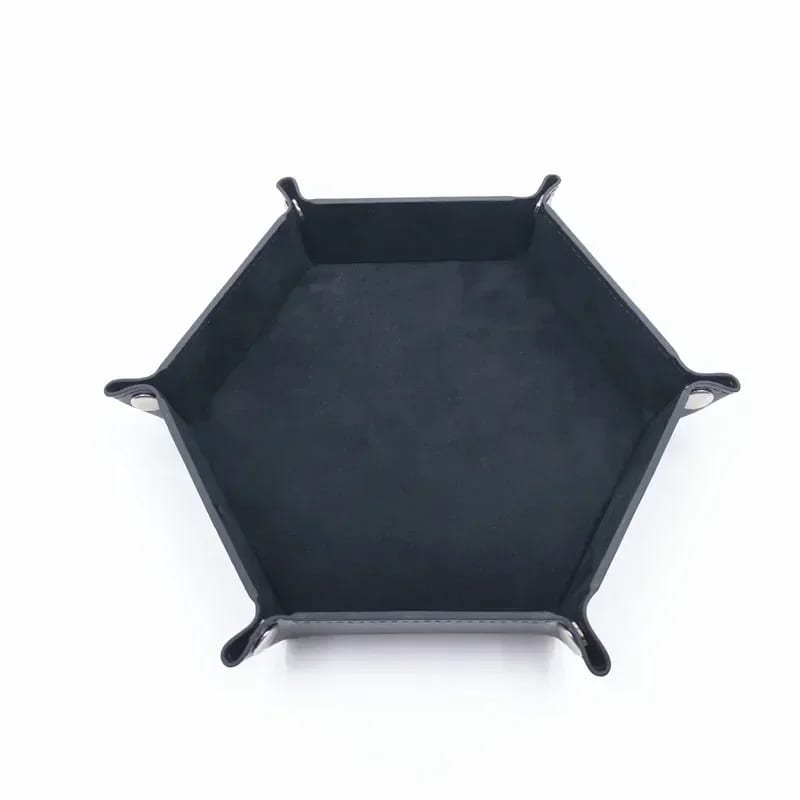
Most players bring their own set — and then another, and then a set for each character. Metal dice are heavier, roll with a solid sound and last forever; a rolling tray keeps them on the table. How to choose your dice · RPG dice sets explained.