Chinese Checkers Strategy: How to Win
Nov 7, 2026 · The Editors
Chinese checkers strategy for beginners and beyond: building ladders, long hop chains, keeping no stragglers, using other players' marbles, blocking, and the endgame — plus where the game really came from.
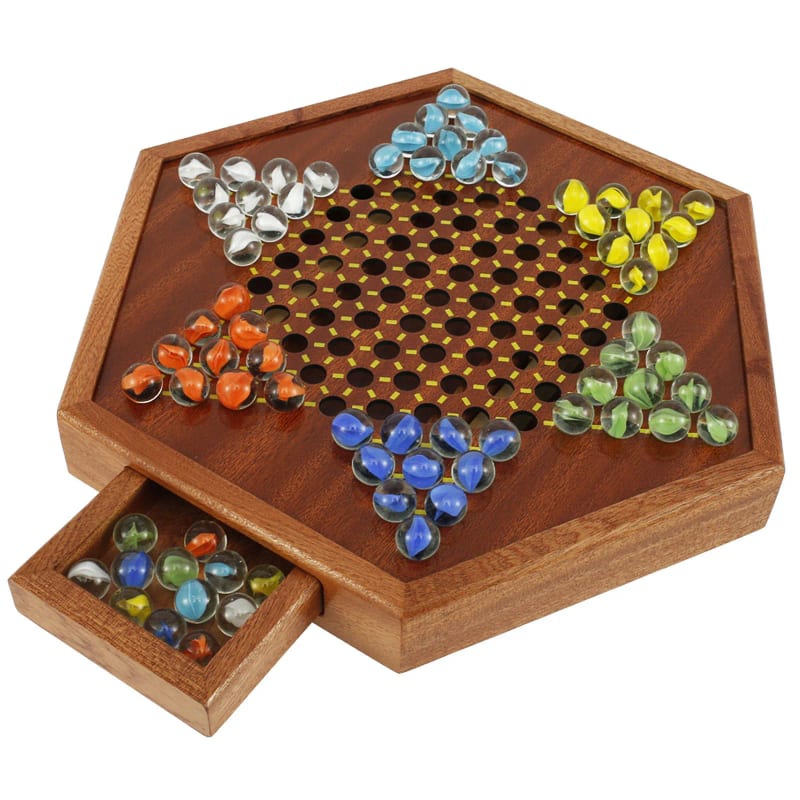
Chinese checkers looks like a game of luck, but it is a race — and races are won by planning. These principles will win most games against casual players. (New to the game? Start with the Chinese checkers rules.)
1. Think in hops, not steps
A step moves one hole. A hop chain can move a marble across the whole board in one turn. Every turn, look first for the longest hop available — for any of your marbles — before you consider a step.
2. Build a ladder
The core strategy: arrange your marbles in a line with gaps between them, pointing towards your goal. Then your back marble can hop all the way along the line to the front — and the next one can do the same.
Each turn, either extend the ladder or use it. A good ladder lets you move a marble six or eight holes per turn.
3. Leave no stragglers
The most common way to lose is a single marble left behind at home with nothing to hop over. It has to walk the whole board one step at a time, and that costs five or six turns.
Move your back marbles early, and keep the group together. The last marble out of your starting point should not be left alone.
4. Use other players' marbles
Any marble can be hopped — yours or anyone else's. The middle of the board is full of other people's marbles; use them as stepping stones. Watch for the hop chains your opponents are building and borrow them.
5. Don't build ladders for your opponents
The flip side: a ladder pointing in the right direction for an opponent is just as useful to them. Watch where your marbles are relative to their path, and avoid leaving perfect stepping stones in front of the player heading the other way.
6. Blocking
In the standard rules, you may not be prevented from entering your goal, but marbles left sitting in other players' home triangles can slow them badly. House rules differ on how long marbles may stay in another player's destination. Agree first — and if blocking is allowed, a well-placed marble or two can cost an opponent several turns.
7. The endgame
As your marbles arrive, fill the far corners of your goal first — the tip of the triangle — and leave the front holes for last. Marbles that block your own entrance cost you moves at the end. Plan the last few marbles together: the final three or four moves of the game are where most races are won or lost.
With two players
With two, each player can use 15 marbles (filling the whole star point, in some versions) or the usual 10. The board is emptier, so ladders matter even more — and so does not building one for your opponent.
Where Chinese checkers came from
It is not Chinese. The game was invented in Germany in 1892 as Stern-Halma — a star-shaped version of the older game Halma — and given the name "Chinese checkers" by American marketers in the late 1920s to make it sound exotic.
A wooden board with drawers for the marbles makes it a handsome game to leave out on the coffee table.