Chinese Checkers Rules: How to Play with 2, 3, 4 or 6 Players
Nov 4, 2026 · The Editors
How the marbles move, how hopping works, and which points to use for every number of players — the full rules of Chinese checkers.
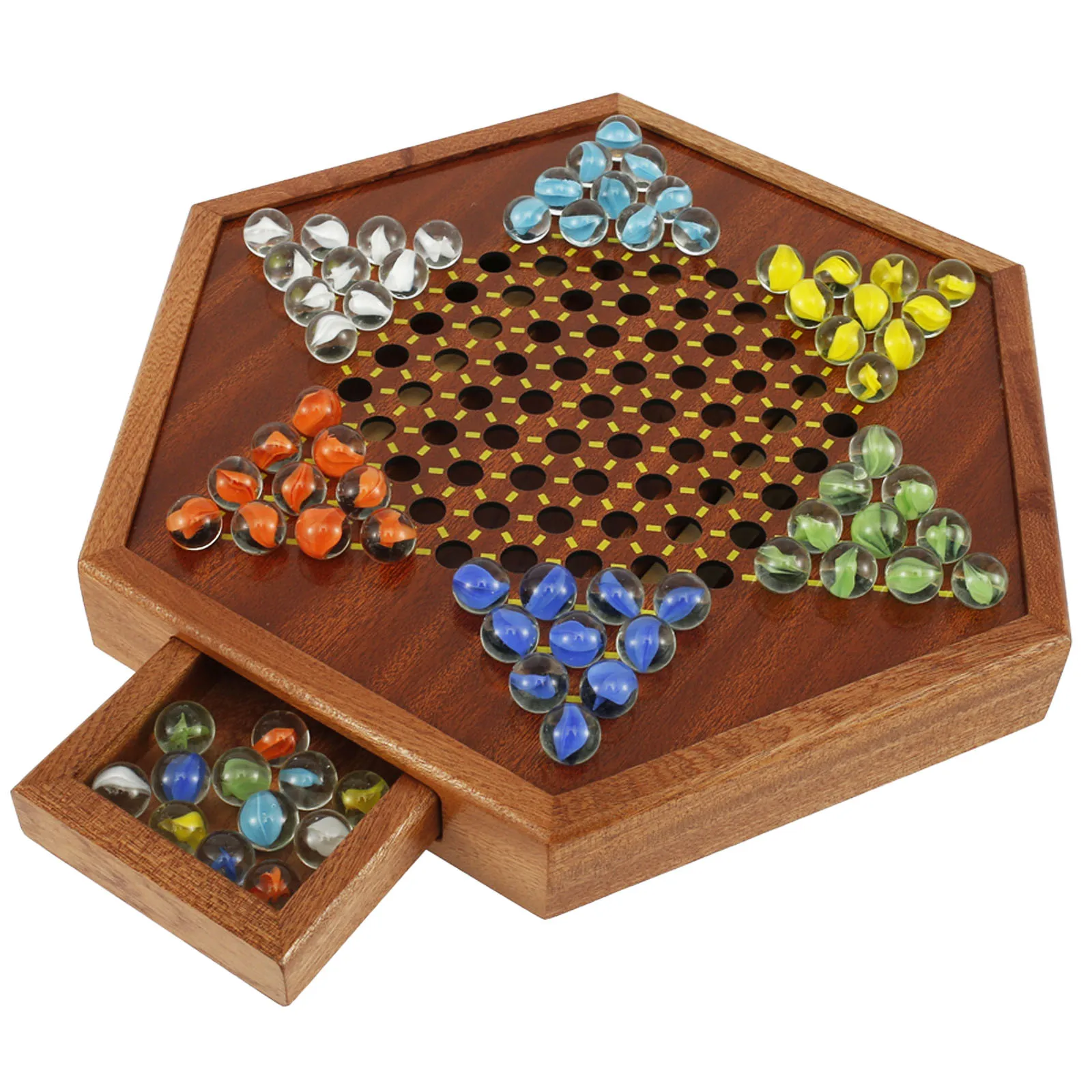
Chinese checkers is played on a six-pointed star. Each player starts with a set of marbles in one point of the star and races to move all of them into the point directly opposite. There is no capturing, and there is no luck — just stepping, hopping, and getting in each other's way.
The board and the marbles
The star has six triangular points, each holding ten marbles in the standard game. Each colour belongs to one point. The point directly across the board is where that colour is trying to go.
Setup by number of players
- Two players: use two opposite points. Some players use fifteen marbles each for a longer game.
- Three players: use three points with an empty point between each, so nobody starts opposite anyone.
- Four players: use two pairs of opposite points, leaving two opposite points empty.
- Six players: everyone plays, each from their own point.
Five players is possible but leaves one player without an opponent heading toward them, so it is rarely played.
How to move
On your turn you move one marble, in one of two ways:
- Step into any empty hole next to it, in any of the six directions.
- Hop over a single adjacent marble — yours or anyone else's — into the empty hole directly beyond it.
The power is in the hopping. You can chain hops in one turn: after landing, if another hop is available, you may take it, and keep going in any direction for as long as the hops line up. A single marble can cross half the board in one move. You cannot mix a step and a hop in the same turn.
Marbles are never removed. Hopping over an opponent's marble does not capture it.
Winning
The first player to fill the opposite point with all of their marbles wins. Play often continues for second and third place.
House rules to agree on
- Whether you may stop in, or hop through, a point that belongs to a player not in the game.
- Whether a player may leave a marble sitting in their own starting point to block an opponent. Most groups say no once the game is under way.
Strategy in one paragraph
Build ladders: line your marbles up so that each one gives the next a hop, and you can move a whole column forward in a few turns. Don't leave stragglers at the back. And watch the hops you are giving your opponents — every marble you place is a step for somebody.
The name
Despite the name, the game is not Chinese. It was invented in Germany in the 1890s as Stern-Halma, a star-shaped version of the English game Halma, and was given its "Chinese" name by American marketers in the 1920s and 30s. The name stuck everywhere.
Mentioned above