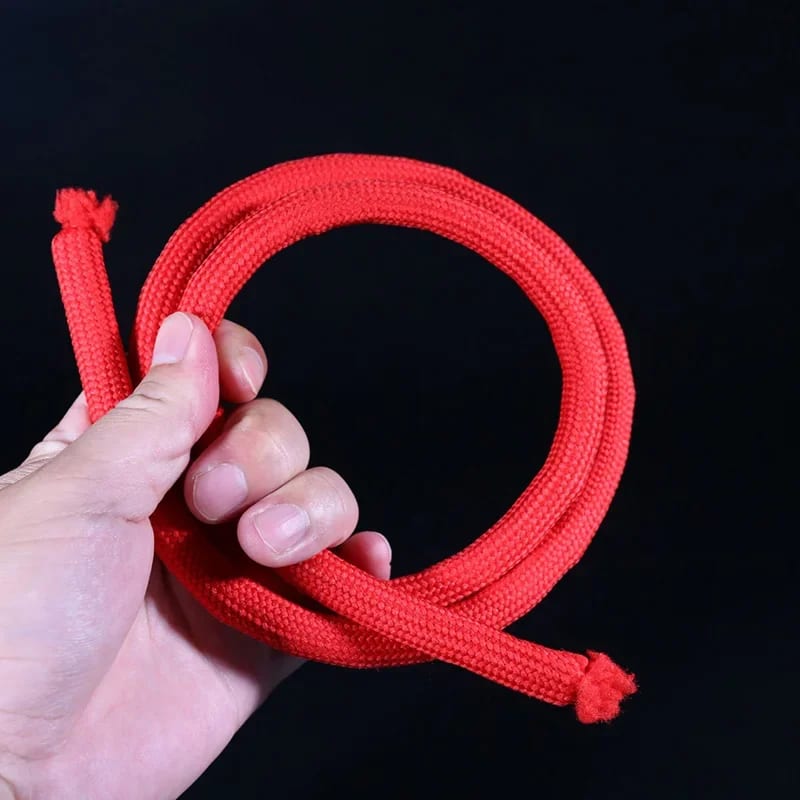
Cut and Restored Rope
$11.99Beginner
A length of rope is cut cleanly in half in front of everyone, the ends are tied, and the rope comes back whole — with the knot removed last.
What they see
A rope is held up, its middle is found, and scissors cut through it. Two ends fall. Everyone has seen the cut and heard it.
The halves are knotted together and the knot is shown around. Then the rope is drawn through a closed hand and the knot comes off in the fingers, leaving one unbroken length that is immediately handed out.
The version that plays best in a small room cuts the rope three times and restores it three times, each one faster than the last, so the audience is still deciding whether they believe the first when the third has already happened.
Provenance
The plot is old enough that nobody owns it. Rope restorations appear in conjuring literature through the nineteenth century, and the modern handling owes most to the mid-twentieth-century close-up workers who moved it off the stage and onto a table a few feet from the spectators.
It survives because the props are honest. A rope is a rope — there is no box, no cabinet, nothing to suspect but the performer's hands, which is why it stayed in the repertoire while a great deal of apparatus magic from the same period did not.
Learning it
The first restoration is learnable in an afternoon and will fool people the same evening.
The difficulty is the second and third. Repeating an effect invites scrutiny, so each repeat has to be cleaner than the last and look different while being the same. Most performers learn one cut, perform it for a year, and only then add the rest.
Buy more rope than you think. This is an effect you practise by destroying the prop, and a routine worked out on a short offcut will not behave the same on a full length.
What you need
Next
Transformation
Two balls that look identical. One bounces to the ceiling and the other hits the floor dead — and they swap over in a spectator's hands.
Appearance
A small red ball is placed in the spectator's own closed fist. When they open it there are two — the effect that happens in someone else's hand rather than yours.
Vanish
A small ball in a turned wooden or brass vase vanishes, returns, and changes place — the prop that has been in beginners' boxed sets for over a century.