What Is Speedcubing? Events, Methods and Getting Started
Nov 14, 2026 · The Editors
What is speedcubing: solving puzzle cubes against the clock, how official competitions and averages work, the main methods, the terms (AUF, OLL, PLL) and how to start.
Speedcubing is solving a twisty puzzle cube — most often the 3×3 — as fast as possible, usually against a timer and often in competition. Top solvers finish a scrambled 3×3 in a few seconds; a beginner using a layer-by-layer method takes a minute or two, and most people who practise regularly get under 30 seconds.
How speedcubing competitions work
Official competitions are run under the rules of the World Cube Association (WCA), founded in 2004. At a competition:
- Every competitor gets the same scrambles, generated by computer.
- Before each solve you get 15 seconds to inspect the cube.
- Most events are scored as an average of five: the fastest and slowest of five solves are dropped, and the middle three are averaged.
- A timer started and stopped with both hands records each solve.
Events include the 2×2 up to the 7×7, the 3×3 one-handed, blindfolded solving, fewest moves (finding the shortest solution on paper) and several other shapes of puzzle.
Speedcubing methods
A method is the plan of steps you follow. The main ones for the 3×3:
| Method | Steps | Known for |
|---|---|---|
| Beginner's layer-by-layer | Cross, first layer, second layer, last layer | Easy to learn; where everyone starts |
| CFOP (Fridrich) | Cross, F2L, OLL, PLL | The most popular method at the top |
| Roux | Blocks, then corners and edges with middle-slice moves | Fewer moves, popular for one-handed |
| ZZ | Edge orientation first, then blocks | Smooth turning without cube rotations |
The fastest method is still debated: most world-class solvers use CFOP, but Roux and ZZ users also reach the top. The easiest is the beginner's method — see how to solve a 3×3 cube.
Speedcubing terms
- F2L — first two layers, solved together in pairs.
- OLL — orientation of the last layer: making the top face one colour.
- PLL — permutation of the last layer: moving those pieces into place.
- AUF — adjust upper face: the final turn of the top layer to line it up.
- COLL — a set of algorithms that orients and permutes the last-layer corners at once.
- VLS — a technique that solves the last F2L pair and orients the last layer in one step.
- TPS — turns per second.
- Algorithm — a memorised sequence of moves, written in cube notation.
Full CFOP uses 57 OLL and 21 PLL algorithms; most cubers learn a shortened "two-look" version first.
The speedcubing world record
World records are broken often, so any figure goes out of date quickly. Both the 3×3 single and the average-of-five records now sit at around four seconds or less. The WCA publishes the current records.
Why speed cubes are different
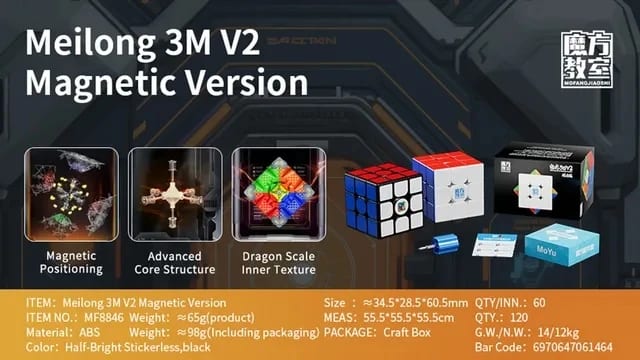
A speed cube turns faster and more smoothly than an ordinary puzzle cube. Most have:
- Magnets inside, which help each layer settle into line so turns stay accurate at speed.
- Corner cutting — the cube still turns when a layer is slightly out of line.
- Adjustable tension, so you can tune how loose or firm it feels.
A magnetic speed cube is the best way to start; an old stiff cube makes learning slow and frustrating.
How to start speedcubing
- Learn the beginner's method until you can solve without notes.
- Time yourself, and keep a list of times — progress is very motivating.
- Move to two-look CFOP: learn F2L intuitively, then a handful of OLL and PLL algorithms.
- Practise finger tricks — turning with fingertips rather than whole-hand grips.
- Find a local competition. Beginners are welcome at WCA events.
If cubes aren't your thing, other mechanical puzzles reward the same patience — see gifts for puzzle lovers.
Frequently asked questions
What does speedcubing mean?
It means solving a puzzle cube, usually the 3×3, as fast as possible against a timer, often in official competitions.
What is the best speedcubing method?
CFOP is the most widely used at the top level. Roux and ZZ are strong alternatives, and the beginner's layer method is the easiest to learn first.
What is AUF in speedcubing?
Adjust upper face: the last turn of the top layer that lines it up with the rest of the cube.
Do you need a special cube for speedcubing?
You can start with any cube, but a magnetic speed cube turns faster and more accurately and makes learning much easier.