Memento Mori Meaning: Remember You Will Die, and Why That Helps
Nov 4, 2026 · The Editors
What memento mori means, where the idea comes from — the Stoics, the Roman triumph, the vanitas painters — and why people carry a memento mori coin.
Memento mori is Latin for "remember that you will die". Said like that it sounds bleak. It was never meant to be. The point of remembering that your time is limited is to stop wasting it — on grudges, on putting things off, on worrying about what other people think.
Memento mori meaning in English
Word for word: memento, "remember" (an instruction, addressed to you), and mori, "to die". So: remember to die — remember that you must die. The phrase itself is best known from medieval Christian use, but the idea behind it is much older.
Where the idea comes from
The Stoics. The Roman Stoic philosophers returned to it again and again. Seneca wrote that we should live each day as if it completes our life. Marcus Aurelius, emperor and Stoic, reminded himself in his private notebooks — the book we call the Meditations — that he could leave life at any moment, and should let that decide what he did and said. Epictetus told his students to keep death before their eyes every day, so they would never think a mean thought or want anything too much.
The Roman triumph. A favourite story says that when a victorious general rode through Rome in triumph, a slave stood behind him whispering memento mori. The ancient sources tell it a little differently — the Christian writer Tertullian has the voice saying "look behind you; remember you are a man" — but the meaning is the same: at the height of your glory, remember you are mortal.
Christian tradition. For the medieval church the reminder was a call to live well while there was time. It survives in the words of Ash Wednesday, "remember that you are dust, and to dust you shall return", and in skulls carved on tombs and painted in chapels.
The vanitas painters. In the 1600s, Dutch and Flemish artists painted still lifes built around the same thought: a skull, an hourglass, a guttering candle, flowers just past their best, a watch. Every object says the same thing — time is passing, so use it.
The symbols
- The skull — the plainest reminder there is.
- The hourglass — time running out, grain by grain.
- The reaper — death personified, with his scythe.
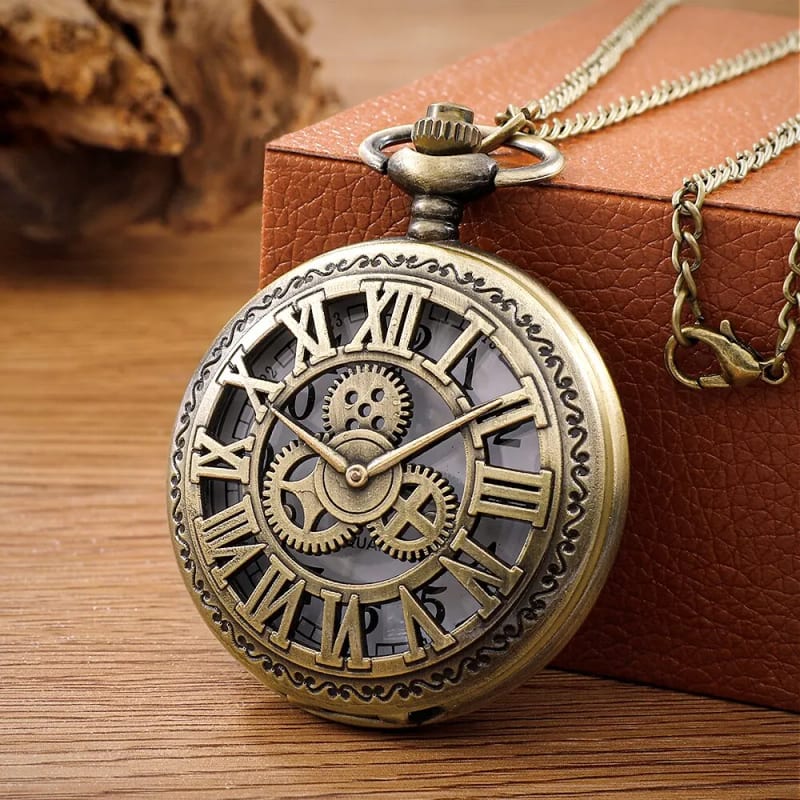
- Clocks and watches — the hours you have, counting down.
- Flowers and roses — beauty that does not last.
Memento mori, memento vivere
The phrase has a partner: memento vivere, "remember to live". They are two sides of one idea, and they are often paired on coins and in tattoos. Its other companion is carpe diem, "seize the day" — the subject of a guide of its own — and many people add amor fati, "love of fate", a phrase from the philosopher Nietzsche that has become attached to modern Stoicism.
Why people carry a memento mori coin
A reminder only works if you meet it. That is the case for a coin: it lives in a pocket, and every time your hand finds it — reaching for keys, waiting in a queue — you are reminded. Many people who practise Stoicism today carry one for exactly that reason, and turn it over when they catch themselves putting off something that matters.
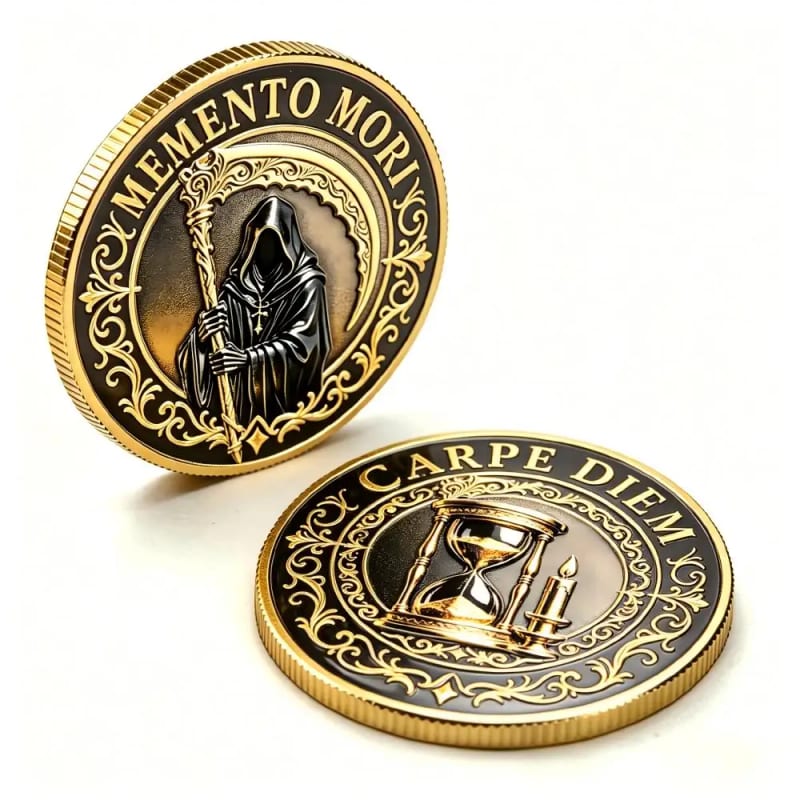
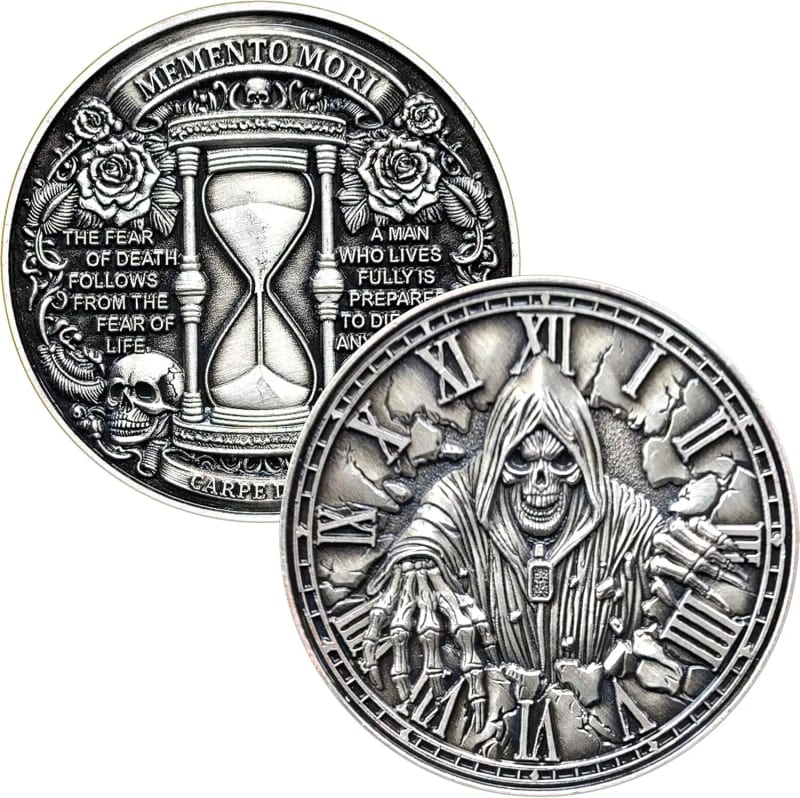
Our silver coin is struck in deep relief: an hourglass between roses and skulls under MEMENTO MORI on one side, with a line usually attributed to Mark Twain — "The fear of death follows from the fear of life. A man who lives fully is prepared to die at any time." — and the reaper reaching out of a Roman-numeral clock face on the other. The gold coin pairs the reaper with an hourglass and CARPE DIEM.
As a gift
A memento mori coin is a thoughtful present for someone starting something — a new job, a new decade, a recovery — or for anyone who reads the Stoics. It is not a morbid gift, if you explain it: it is a gift that says your time matters.
Both are commemorative pieces with a plated finish. They copy no currency and are not silver or gold bullion.