How to Spin a Spinning Top — and Why It Stays Up
Nov 5, 2026 · The Editors
How to spin a spinning top without string, the surface that makes it spin longest, the physics of why a top stays upright and wobbles at the end, and a little history.
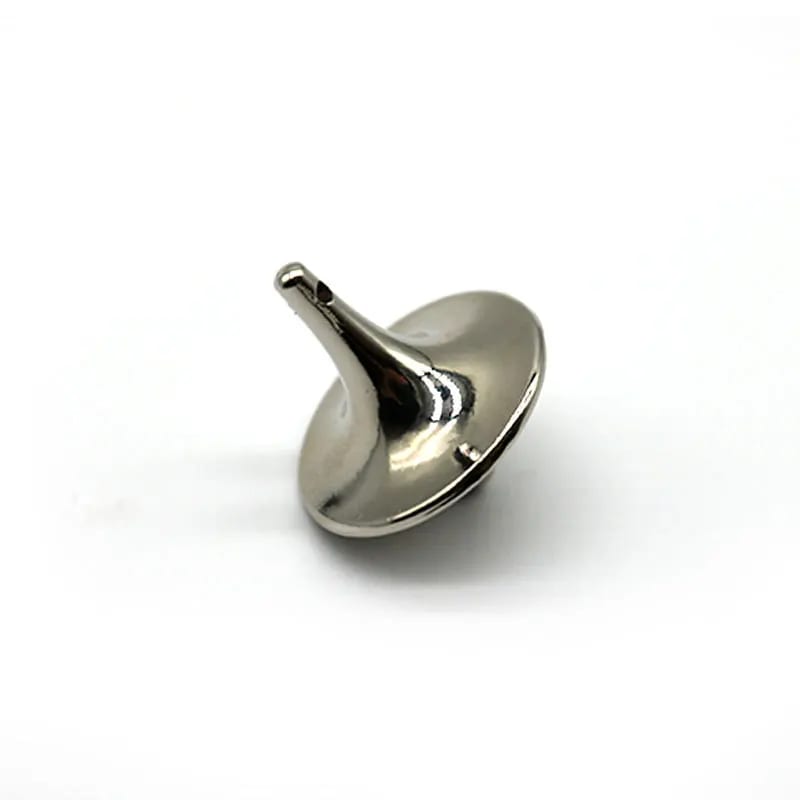
A spinning top is about as old and as simple as a toy can be, and it still holds a room's attention: a little metal shape, balanced on a point that should not be able to hold it up, humming quietly until it slowly gives in. Here is how to spin one well, and why it works at all.
How to spin a top without string
Small finger tops — like a precision metal desk top — are spun by hand.
- Pinch the stem between your thumb and middle finger, near the top. Hold it upright, with the point just touching the surface.
- Twist sharply — snap your fingers past each other, as if clicking them — and let go in the same instant.
- Keep your hand still as you release. A sideways push sends the top skating off instead of spinning in place.
Right-handed spinners usually twist clockwise, but either way works. If it topples straight away, the twist was too slow or the stem was tilted; try again with a quicker snap.
The surface matters
A top loses its spin mostly through friction at the point. A hard, smooth, flat surface — glass, a glazed ceramic plate, a polished stone worktop — gives the longest spins. Wood, fabric and anything soft or textured drag at the point and end the spin early. A slightly concave dish keeps the top from wandering off the edge.
Why a spinning top stays upright
A top that is not spinning falls over at once. A spinning one does not, because of angular momentum: a spinning object resists any change to the direction of its spin axis. When gravity tries to tip the top over, it does not fall — instead its axis slowly swings round in a circle. That slow circling is called precession, and it is the same effect that steadies a gyroscope.
The faster the top spins, the steadier it stands. A good top puts its weight low and wide and keeps its point fine, so it has plenty of spin to spend and little to lose at the point.
Why it wobbles at the end
Friction at the point and against the air slowly steals the spin. As it slows, the precession gets wider and faster — the top starts to wobble — until the spin can no longer hold it up and it rolls over. The last few seconds of a spin, when it seems certain to fall and does not, are the best part.
A very short history
Spinning tops are among the oldest toys known: archaeologists have found them in ancient sites across the world, made of clay, wood, bone and stone. Whip tops, string tops and finger tops have all been played with for centuries, and in many countries spinning contests are still a traditional game. Precision metal tops are the modern collector's version: machined, balanced and built for one thing, the longest possible spin.
On the desk
A metal top is a near-perfect desk toy: small, silent, impossible not to pick up, and good for a minute's distraction that ends on its own. Set one going in the middle of a dinner table and watch everyone stop talking until it falls.