How to Play Dominoes: Rules for 2, 3 or 4 Players
Nov 4, 2026 · The Editors
The block game, the draw game and All Fives — how to play dominoes with a double-six set, for any table from two players to four.
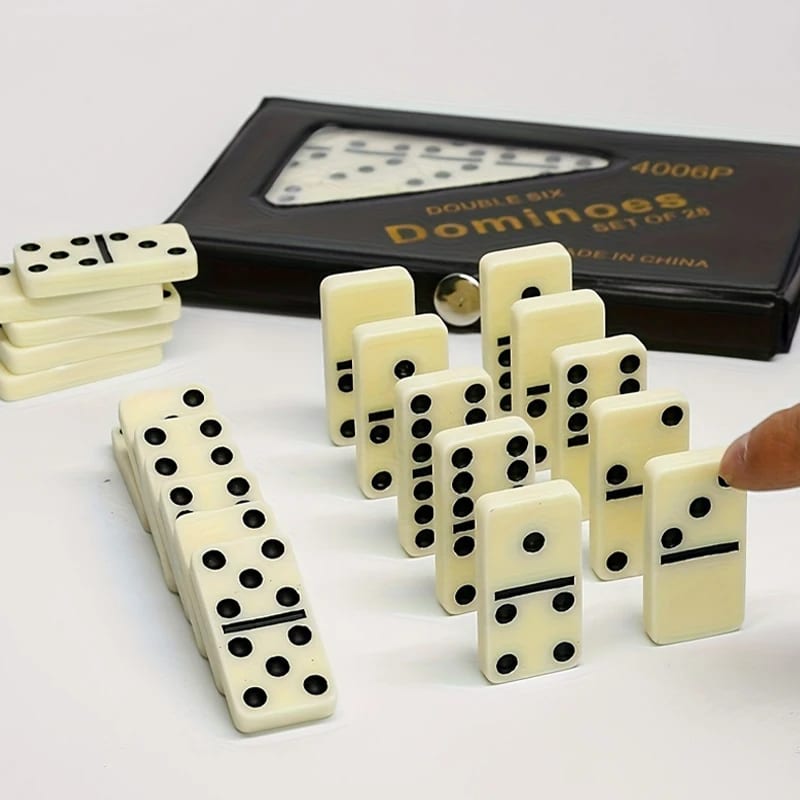
Dominoes is a family of games played with rectangular tiles, each marked with two numbers. The classic set is the double-six: 28 tiles, one for every pairing of the numbers 0 to 6. The basic game takes a minute to learn and a lifetime to play well.
The tiles
Each domino has two ends, each showing 0 to 6 pips. A double has the same number on both ends. The total pips on a tile is its weight: the 6-6 is the heaviest.
Setup
Turn all 28 tiles face down and shuffle them. Each player draws:
- 2 players: 7 tiles each
- 3 players: 7 tiles each (some play 5)
- 4 players: 7 tiles each, which uses every tile
The tiles left over are the boneyard.
Players stand their tiles on edge so only they can see the faces.
Starting
The player with the highest double leads it. If nobody has a double, the heaviest tile leads. Play then goes to the left.
Playing
On your turn, play one tile that matches an open end of the line: a tile with a 4 can go against an open 4. Doubles are usually placed crosswise, and in many games both of their sides count as one end.
When you cannot play
- Block game: you pass. If nobody can play, the game is blocked and ends.
- Draw game: you draw from the boneyard until you can play. When the boneyard is empty, you pass.
Agree which you are playing before you start. The draw game is more forgiving for beginners.
Ending a hand
A hand ends when one player plays their last tile — "domino!" — or the game is blocked. The winner scores the total pips left in the other players' hands. In a blocked game, the player with the lightest hand wins.
Play to an agreed total, often 100 or 150.
Partners
With four players, the people sitting opposite are often partners, and the team pools its points. Partnership play is where dominoes becomes a game of signals and memory.
All Fives (Muggins)
The most popular scoring variation. After each play, add up the open ends of the whole layout. If the total is a multiple of five, the player who made it scores that many points. Doubles at an end count both halves. It rewards counting ahead, and it is the version most serious players prefer.
A little history
Dominoes began in China, where tile games are recorded from around the twelfth century. The European game appeared in Italy in the eighteenth century and spread from there; the name is usually linked to the black-and-white hooded cloak called a domino.
Mentioned above