How to Play Backgammon: Rules and Setup for Beginners
Nov 4, 2026 · The Editors
The setup, how the checkers move, hitting, bearing off and the doubling cube — backgammon explained from the first roll.
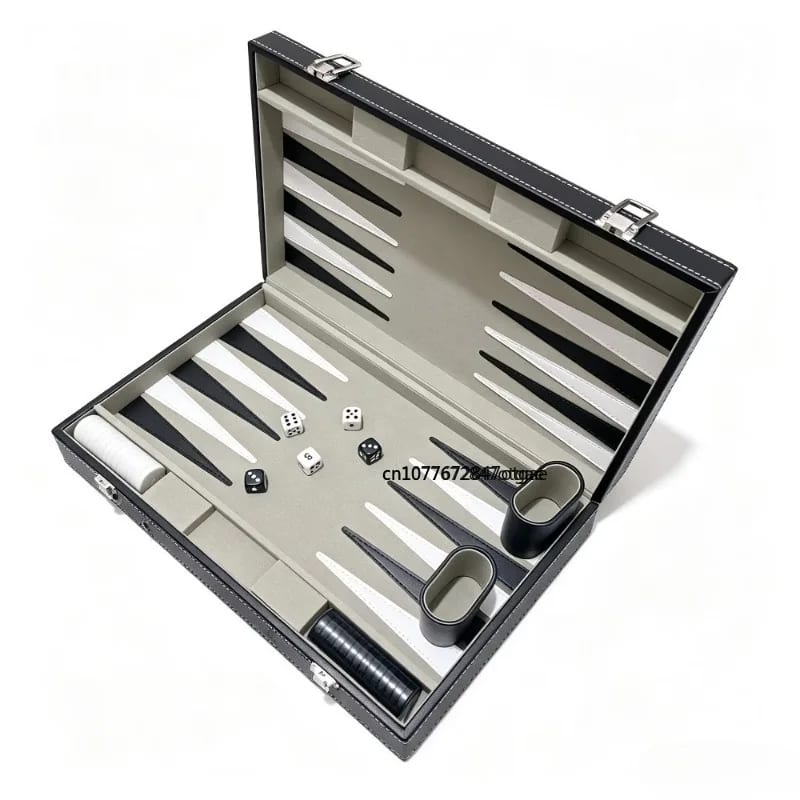
Backgammon is one of the oldest board games in the world, and one of the best: a race with dice in which every roll forces a decision. The rules fit on a page. The strategy takes a lifetime.
The board and the setup
The board has 24 narrow triangles called points, in four quarters of six. Each player has 15 checkers and moves them around the board in opposite directions, from the far side toward their own home board.
Number the points 1 to 24 from your own point of view, with 1 to 6 being your home board. Set up your checkers like this:
- 2 on your 24-point (the far corner, in your opponent's home board)
- 5 on your 13-point (the middle of the far side)
- 3 on your 8-point
- 5 on your 6-point
Your opponent sets up the mirror image. You move from 24 down toward 1; they move the other way.
Starting
Each player rolls one die. The higher roll goes first, using both numbers rolled. After that, players roll two dice on each turn.
Moving
- Each die is a separate move. Roll a 5 and a 2, and you move one checker 5 points and one checker 2 points — or the same checker 5 and then 2.
- Doubles count twice: roll two 4s and you move 4 four times.
- You may land on an empty point, a point with your own checkers, or a point with one opposing checker. You cannot land on a point holding two or more of your opponent's.
- You must use both dice if you can. If only one can be used, you must use the larger if possible.
Hitting and the bar
A single checker alone on a point is a blot. Land on it and you hit it: it goes to the bar in the middle of the board. A player with a checker on the bar must bring it back in, into the opponent's home board, before moving anything else. If the entry points are blocked, they lose the turn.
Bearing off
Once all 15 of your checkers are in your home board, you can start bearing off: removing them from the board with the dice. A 4 takes off a checker from the 4-point. If you roll higher than your furthest checker, you can bear off from the highest point you have. If one of your checkers is hit while bearing off, it must come all the way round again before you continue.
Winning — and winning big
The first to bear off all 15 checkers wins.
- If the loser has borne off at least one checker, it is a single game.
- If they have borne off none, it is a gammon: worth two.
- If they have none off and a checker still on the bar or in the winner's home board, it is a backgammon: worth three.
The doubling cube
The cube with 2, 4, 8, 16, 32 and 64 on it raises the stakes. Before rolling, a player who thinks they are ahead may offer to double. The opponent either accepts, and the game is now worth twice as much (and they own the cube, so only they can double next), or declines and loses the game at its current value. It turns a game of luck into a game of nerve.
A few beginner habits
- Do not leave blots where your opponent can easily hit them.
- Build blocks of points in a row — a prime — to trap opposing checkers behind it.
- When you are behind in the race, hit and hold; when you are ahead, just run.
A little history
Games played on this board are thousands of years old; a close ancestor was played in ancient Persia, and the Romans played a cousin called tabula. The modern game, with the doubling cube, took its shape in the 1920s.
Mentioned above