Chinese Poker Rules: How to Set Your Hands and Score
Nov 14, 2026 · The Editors
Chinese poker rules: dealing 13 cards, setting the back, middle and front hands, fouling, the two scoring systems, royalties and the open-face version.
In Chinese poker each player is dealt 13 cards and arranges them into three poker hands: a five-card back hand, a five-card middle hand and a three-card front hand. The back must be the strongest and the front the weakest. Then everyone reveals, and each of your three hands is compared with the matching hand of every opponent. There is no betting during the hand — it is a game of arranging, not bluffing.
What you need
- Two to four players. Four uses the whole deck.
- One 52-card deck, no jokers.
- Chips or a score sheet — players usually agree a value per point.
The deal and setting your hands
Deal 13 cards to each player. Each player privately sorts them into:
| Hand | Cards | Rule |
|---|---|---|
| Back (bottom) | 5 | Must be the strongest of your three |
| Middle | 5 | Must be weaker than or equal to the back |
| Front (top) | 3 | Must be the weakest |
Hands use the normal poker hand rankings. The three-card front hand can only be a high card, a pair or three of a kind — straights and flushes do not count in three cards.
When everyone is ready, all players set their hands face down and reveal together.
Fouling
If your hands are out of order — say your middle hand beats your back hand — you have fouled. A fouled hand loses all three rows to every opponent who did not also foul. Check your order before you reveal; it is the most common way to lose a point swing.
Scoring
Each player is compared with each other player, row by row. There are two common systems.
The 1-6 method (the most common):
- Win a row: 1 point from that opponent.
- Win all three rows against one opponent ("scooping"): 3 bonus points, so 6 in total.
The 2-4 method:
- 1 point for each row won, plus 1 point for winning two rows out of three — so a 2-1 result is worth 2 and a sweep is worth 4.
Ties in a row usually score nothing.
Royalties
Many games add royalties — bonus points for strong hands in a given row — such as a bonus for four of a kind or a straight flush in the back, or for three of a kind in the front. The amounts vary from table to table, so agree a list before you start. Royalties reward taking a risk on a big hand instead of spreading strength evenly.
Open-face Chinese poker
In open-face Chinese poker, cards are dealt a few at a time and placed face up. Each player receives five cards first and sets them on the board, then receives cards one at a time (or three at a time, keeping two and discarding one, in a popular form), placing each before seeing the next. Once placed, a card cannot be moved. Fouling and royalties work as above. Some versions add a "fantasyland" bonus round for a strong front hand. It is a more recent variant and its rules differ between games.
Strategy for Chinese poker
- Build the back first. Find your strongest five cards; they almost always go at the back.
- Don't waste strength. A full house in the back and nothing in the middle loses two rows. Balance usually beats one monster hand.
- A pair in front is valuable. Most front hands are just high cards, so even a small pair wins it often.
- Check the order twice. A foul is worse than a weak arrangement.
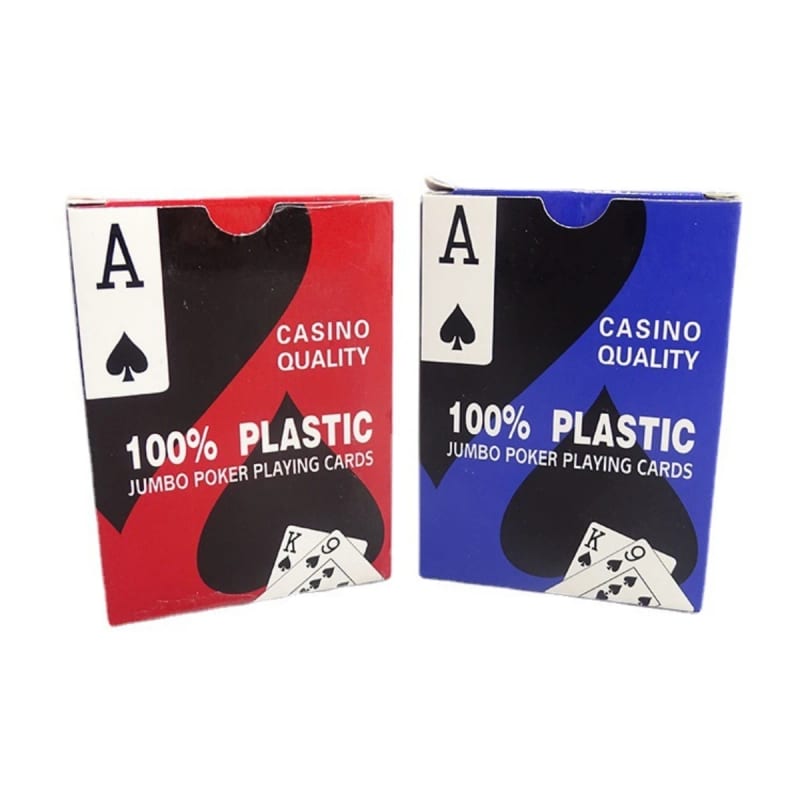
Jumbo indexes make all 13 cards easy to read while you sort. For more poker variants, see types of poker games.
Frequently asked questions
How many cards do you get in Chinese poker?
Thirteen. You arrange them into a five-card back hand, a five-card middle hand and a three-card front hand.
What happens if you foul in Chinese poker?
You lose all three rows to every opponent who did not foul, usually including the scoop bonus.
Can you have a straight in the front hand?
No. The three-card front hand counts only high cards, pairs and three of a kind.
What is open-face Chinese poker?
A version where cards are dealt a few at a time and placed face up, one decision at a time, so you build your three hands without seeing the full 13 cards first.